
When people decide to improve their lives, they often focus on dramatic transformations. They create ambitious goals, build detailed plans, and promise themselves that everything will change overnight. While enthusiasm can be powerful, it rarely lasts forever. What truly shapes our lives is not what we do occasionally, but what we do consistently.
This is why small habits are so powerful.
At first glance, tiny habits seem insignificant. Reading a few pages each day, taking a short walk, organizing your workspace, or spending a few minutes planning tomorrow may not appear life-changing. Yet these actions have a unique characteristic: they compound over time.
Imagine improving just one percent every day. The difference may be invisible at first, but weeks and months later the results become remarkable. Success rarely arrives as a sudden breakthrough. More often, it is the consequence of countless small actions repeated consistently.
One reason people underestimate small habits is that they focus too much on immediate results. Modern culture encourages instant gratification. We want quick progress, fast solutions, and visible outcomes. When a new habit doesn’t produce dramatic changes within a few days, many people abandon it.
However, personal growth works differently.
The early stages of improvement are often invisible. A person who starts exercising may not see physical changes immediately. Someone learning a new skill may feel like they’re making little progress. A writer may spend months creating content before seeing any meaningful audience growth.
This period can be frustrating because effort and results appear disconnected.
But beneath the surface, change is happening.
Every repetition strengthens a behavior. Every action reinforces an identity. Over time, habits stop feeling like tasks and become part of who we are. Instead of forcing yourself to read, you become someone who reads. Instead of trying to be organized, you become an organized person.
This shift in identity is one of the most important aspects of habit formation.
Many people focus exclusively on goals. Goals are useful because they provide direction. However, goals alone do not create lasting change. Systems do. A goal tells you where you want to go. Habits determine whether you get there.
Consider two people who want to improve their productivity. One sets a goal to become more productive. The other creates a habit of planning the next day every evening for five minutes. After several months, the second person is more likely to see meaningful improvement because their focus is on a repeatable behavior rather than a desired outcome.
Another advantage of small habits is sustainability.
Large changes require significant motivation and energy. Small habits require very little. On difficult days, it’s easier to maintain a tiny habit than a major commitment. Reading one page feels manageable. Taking a five-minute walk feels achievable. These small victories maintain momentum even when motivation is low.
Consistency is often more valuable than intensity.
Many people work extremely hard for short periods before burning out. Others progress steadily through small daily actions. While dramatic efforts may produce temporary results, consistency tends to win in the long run.
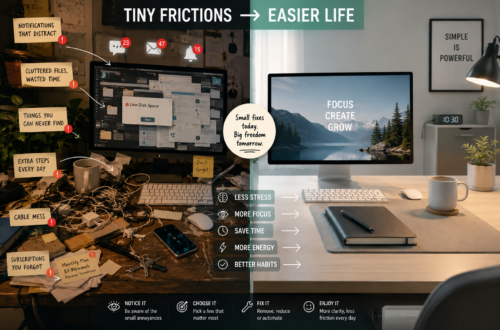
The environment also plays an important role in habit formation. Human behavior is heavily influenced by surroundings. If good habits are difficult and bad habits are convenient, progress becomes challenging. Small changes to the environment can make positive behaviors easier and more automatic.
For example, placing a book on your desk increases the likelihood of reading. Preparing workout clothes in advance reduces friction before exercise. Keeping distractions out of sight improves concentration. These adjustments may seem minor, but they significantly influence daily decisions.
Technology can either support or sabotage habits.
Many digital tools are designed to capture attention and encourage distraction. Notifications, endless feeds, and constant stimulation compete for focus throughout the day. Becoming more intentional with technology can free up time and mental energy for habits that genuinely improve life.
An important lesson about habits is that perfection is unnecessary.
People often believe that missing one day means failure. In reality, progress is rarely linear. Everyone experiences setbacks, interruptions, and difficult periods. What matters most is returning to the habit rather than abandoning it entirely.
Missing once is a mistake. Quitting completely is a decision.
The most successful people are not necessarily more talented or more disciplined than everyone else. Often, they simply maintain useful habits for longer periods. They understand that meaningful change comes from repetition rather than intensity.
Over time, these habits create a powerful foundation. Better health, stronger relationships, improved skills, increased productivity, and greater confidence often begin with small daily actions that seem insignificant in the moment.
The beauty of small habits is that anyone can start.
You do not need special equipment, extraordinary motivation, or perfect circumstances. You only need a willingness to take one small step and repeat it consistently.
Years from now, you may look back and realize that the biggest improvements in your life started with the smallest actions.
That is the power of small habits.