There is a strange moment that happens at the end of a workday.
You close your laptop.
You tell yourself you’re finished.
You walk away.
And then, approximately eleven minutes later, your brain whispers:
You could probably answer those two emails.
You ignore it.
Then: Maybe just check tomorrow’s schedule.
Fine. You check.
While you’re there, you notice something else.
I should probably organize that.
Then you remember an article you wanted to read.
Then a video about improving your morning routine.
Then you decide that since you’re already thinking about tomorrow, you might as well update your to-do list.
Forty-five minutes later, you’re sitting on the sofa with your laptop open, your phone beside you, and absolutely no idea whether you’re working or relaxing.
Welcome to modern productivity.
We’re very good at starting work.
We seem to have forgotten how to stop.
So I decided to try an experiment.
For seven days, I gave myself one simple rule:
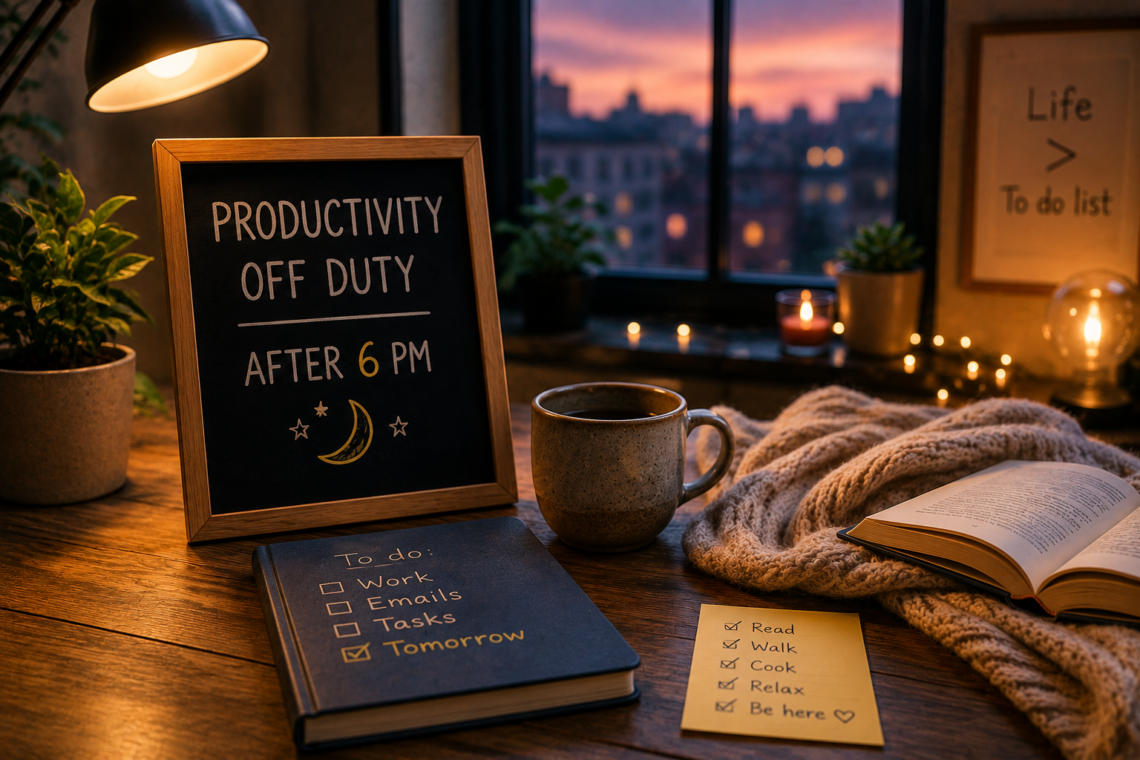
After 6 PM, I was no longer allowed to try to be productive.
No work. No « quick » professional emails.
No optimizing my task system. No productivity videos.
No reorganizing tomorrow’s schedule for the fourth time.
No sneaking in a little work because I happened to have my laptop nearby.
At 6 PM, the productivity department was closed.
I expected this experiment to be easy.
After all, who doesn’t want permission to stop working?
Apparently… me.
The Rule
Before starting, I needed to define what « not being productive » actually meant.
Because otherwise I knew I’d find loopholes.
And my brain is extremely talented at loopholes.
The rule wasn’t that I had to become completely useless after 6 PM.
I could cook.
Exercise.
Read.
Spend time with people.
Go for a walk.
Watch something.
Play a game.
Listen to music.
Learn something because I genuinely found it interesting.
I could even plan something if it was part of normal life.
What I couldn’t do was turn my evening into Workday: Part Two.
The distinction became:
Doing something because I wanted to do it?
Allowed.
Doing something because I felt guilty about not being productive?
Not allowed.
That sounded simple.
It wasn’t.
Day 1 — I Had No Idea What to Do With Myself
At 5:58 PM, I was still working.
At 5:59, I became suspiciously efficient.
Then 6:00 arrived.
Done.
I closed everything.
And immediately experienced something I hadn’t expected:
What now?
Not philosophically.
Literally.
What do I do now?
Normally, there was always another task.
Another message.
Another small improvement.
Another thing I could research.
Another piece of tomorrow I could prepare today.
But suddenly I had several hours that weren’t supposed to produce anything.
I made something to eat.
Then sat down.
Five minutes later, I picked up my phone.
Email.
No.
I put it down.
Then I remembered something I needed to do tomorrow.
I reached for my notes.
No.
Tomorrow.
Then I thought:
Maybe I’ll watch a video.
Excellent.
I opened YouTube.
The first recommendation?
Something about becoming more productive.
Absolutely not.
Apparently, even my algorithm hadn’t been informed that the office was closed.
I Discovered That Free Time Can Feel Uncomfortable
This surprised me.
I’d assumed that removing work would automatically create relaxation.
Instead, it created a vacuum.
And my brain wanted to fill it.
We’ve become incredibly good at filling empty moments.
Waiting in line?
Phone.
Elevator?
Phone.
Five minutes before leaving?
Email.
Ten minutes before bed?
Let’s research something completely unnecessary.
We rarely encounter empty time anymore.
So when several hours suddenly became available, part of me treated them like unused storage space.
Surely we should put something in there.
But the entire point of the experiment was not to.
So I did something radical.
I let the evening remain inefficient.
Day 1 verdict
Relaxation: 4/10
Urge to check work: 8/10
Number of times I invented something « important »: Too many
Main lesson: Having free time and knowing how to use free time are different skills.
Day 2 — The Guilt Arrived
Day 2 was worse.
Not because I had more work.
Because I knew there was work I could be doing.
That’s a very different feeling.
I wasn’t facing a deadline.
Nobody was waiting urgently.
Nothing terrible would happen if I stopped.
And yet a little voice kept saying:
You could get ahead.
Ah.
Getting ahead.
One of productivity culture’s favorite phrases.
The problem with getting ahead is that there is no finish line.
Answer tomorrow’s emails today?
Great.
Now you can start tomorrow’s other work.
Finish that?
Fantastic.
Perhaps start Friday’s work.
Eventually, if you’re sufficiently dedicated, you can spend Tuesday evening worrying about next February.
There is always another thing you could do.
Which means that if your definition of rest is:
« I’ll rest when everything is finished, »
you may have accidentally invented a system in which rest never happens.
The Guilt Wasn’t About Work
This was the first important realization.
The uncomfortable feeling wasn’t:
« Something urgent needs me. »
It was:
« I’m capable of doing something useful right now, and I’m choosing not to. »
That’s different.
Somewhere along the way, I’d started treating unused productive capacity like wasted electricity.
If I had energy, I should use it.
If I had time, I should optimize it.
If I could do something now, why postpone it?
The obvious answer is:
Because you’re a human being, not a warehouse operating at 97% capacity.
But knowing that intellectually and actually behaving like it are surprisingly different things.
Day 2 verdict
Relaxation: 5/10
Guilt: 7/10
Actual emergency caused by stopping at 6: 0
Main lesson: Sometimes the hardest part of resting is believing you’re allowed to.
Day 3 — I Discovered Fake Productivity
This was my favorite discovery of the week.
At around 7 PM, I suddenly felt an overwhelming desire to organize some files.
Very responsible.
Very sensible.
Very productive.
Also completely unnecessary.
The files had survived perfectly well until that evening.
Why did organizing them suddenly feel urgent?
Because I wasn’t allowed to work.
And apparently my brain had found a substitute.
This made me notice something I now call:
Fake Productivity
Fake productivity is work that feels responsible but conveniently avoids whatever matters most.
It includes things like:
Organizing your desktop instead of writing.
Changing your productivity app instead of completing tasks.
Rearranging your calendar.
Color-coding things that were functioning perfectly well without colors.
Reading another article about concentration instead of concentrating.
Watching videos about morning routines at midnight.
Making elaborate lists of work instead of doing work.
Cleaning your desk precisely when a difficult project needs attention.
These activities aren’t inherently useless.
The timing is what makes them suspicious.
Productivity Can Become Entertainment
This sounds contradictory, but I think it’s true.
Productivity itself can become a hobby.
New apps.
New systems.
New methods.
New routines.
New planners.
New AI workflows.
New ways to structure the same seven days humanity has been dealing with for quite a while.
You can spend enormous amounts of time preparing to become productive.
And preparation feels safer than difficult work.
You get the satisfaction of improvement without the discomfort of actually producing something uncertain.
My 6 PM rule exposed this because once actual work was forbidden, my brain started searching for productivity-adjacent entertainment.
Nice try.
Day 3 verdict
Relaxation: 6/10
Fake productivity detected: Significant
Files reorganized: Zero
Civilization affected: Apparently not
Main lesson: Not everything that looks productive deserves your time.
Day 4 — Something Unexpected Happened the Next Morning
This was where the experiment became interesting.
I woke up and started work.
And I wanted to work.
Not in an inspirational movie way.
There was no dramatic sunrise.
No motivational soundtrack.
No eagle flying past the window.
I simply felt more willing to begin.
Normally, when yesterday’s work leaks into the evening, today can feel like a continuation of one extremely long work session.
You never really stopped.
You slept.
But psychologically, the workday remained open.
Now there was a clear separation.
Yesterday had ended.
Today was new.
That distinction mattered more than I expected.
A Finish Line Changes How You Work
Imagine running a race without knowing where it ends.
You’d probably conserve energy.
You wouldn’t know when to push.
And after enough time, you’d become annoyed.
Work can feel similar when there’s no clear stopping point.
If your workday technically ends at 5 PM but you routinely answer messages at 7, check things at 9 and think about tomorrow at 11…
When did work actually finish?
Your brain doesn’t get a clean answer.
But knowing:
« At 6 PM, I’m done. »
changed how I approached the afternoon.
At 4:30, I couldn’t casually postpone something until « later tonight. »
There was no later tonight.
If it mattered, I needed to handle it now or deliberately move it to tomorrow.
That created urgency without panic.
And surprisingly, it sometimes made me more focused before 6 PM.
Constraints Can Improve Focus
Unlimited time sounds wonderful.
But unlimited time encourages postponement.
If I know I can continue working tonight, it’s easier to waste 20 minutes now.
If I know the day has a hard boundary, those 20 minutes suddenly matter.
The rule wasn’t merely protecting my evenings.
It was changing my afternoons.
Day 4 verdict
Morning energy: Better
Starting resistance: Lower
Afternoon focus: Better
Main lesson: A stopping time can improve the time before it.
Day 5 — I Started Enjoying Things Without Optimizing Them
This was probably the strangest day.
I went for a walk.
Just a walk.
Not:
« A 7,000-step cardiovascular productivity walk. »
No podcast at 1.8× speed.
No educational audiobook.
No attempt to use the walk to solve a problem.
I just walked.
Later, I read something.
Not because it was relevant to work.
Not because I could turn it into content.
Not because it would improve some measurable skill.
I was simply interested.
And I realized how easily hobbies can become projects.
We Have Started Optimizing Leisure
Think about the language surrounding free time.
Read more books.
Learn faster.
Exercise efficiently.
Optimize sleep.
Track steps.
Track calories.
Track habits.
Track screen time.
Meditate consistently.
Journal effectively.
Even relaxation now comes with performance metrics.
There is nothing wrong with improving these things.
But occasionally I wonder:
Can we still do anything badly and enjoy it?
Can you paint without becoming a painter?
Run without training for something?
Cook without photographing it?
Read without having a yearly reading target?
Walk without tracking the distance?
Play a game without trying to master it?
Do something simply because the experience itself is enough?
Day 5 reminded me that leisure doesn’t need a return on investment.
Sometimes the return is:
I enjoyed Tuesday evening.
That’s allowed.
Day 5 verdict
Relaxation: 8/10
Things optimized: Very few
World ended: Still no
Main lesson: Enjoyment doesn’t need to justify itself with productivity.
Day 6 — The Rule Failed
Of course it did.
Any seven-day productivity experiment where every day works perfectly is either extraordinarily lucky or suspiciously edited.
Something came up after 6 PM.
It genuinely needed attention.
So I worked.
And here’s the surprising part:
I didn’t feel like the experiment had failed.
Because the rule had never really been about 6:00 PM.
Six o’clock was arbitrary.
The real rule was:
Work shouldn’t automatically expand into every available part of the day.
Sometimes life ignores boundaries.
Deadlines happen.
Emergencies happen.
Opportunities happen.
People need things.
The goal isn’t rigid obedience.
It’s making exceptions exceptions.
The Difference Between an Exception and a Habit
Working late occasionally isn’t necessarily a problem.
Working late automatically is different.
Checking an urgent message at 8 PM isn’t the same as checking email every evening because your hand opens the app before you’ve consciously decided to.
That’s the distinction I started paying attention to:
Did I choose to work, or did work simply continue because I never stopped it?
One is intentional.
The other is drift.
And drift is dangerous because you barely notice it happening.
Day 6 verdict
Rule followed perfectly: No
Experiment ruined: No
Important realization: Yes
Main lesson: A useful boundary can bend without disappearing.
Day 7 — I Didn’t Become Less Productive
This was the result I cared about.
Did stopping at 6 PM make me accomplish less?
Not obviously.
In fact, some work became easier.
I started faster.
I postponed fewer things into the evening.
I became more aware of low-value tasks.
And when I wasn’t working, I was actually not working.
That last point sounds ridiculous until you realize how uncommon it can be.
There’s a huge difference between:
working for eight hours and resting for four
and:
working for eight hours, then spending four hours half-working, half-resting and doing neither particularly well.
The second version may contain more « productive activity. »
But it doesn’t necessarily contain more useful output.
And it definitely contains less rest.
What Nobody Tells You About Productivity
Productivity advice focuses heavily on beginnings.
How to wake up.
How to plan your morning.
How to prioritize.
How to focus.
How to beat procrastination.
How to start deep work.
But endings matter too.
How do you stop?
That’s not a trivial question.
Because modern knowledge work often has no natural ending.
A farmer can see that the field is done for today.
A shop closes.
A factory shift ends.
But digital work?
There is always another email.
Another document.
Another notification.
Another idea.
Another improvement.
Your laptop doesn’t say:
Congratulations. All work has been completed. Please return tomorrow.
It just sits there.
Waiting.
Why “Just One More Thing” Is So Powerful
One more email.
One more edit.
One more check.
One more task.
Individually, each seems harmless.
The problem is that every « one more thing » can create another.
You answer the email.
The reply reminds you about a document.
You open the document.
The document reminds you about tomorrow.
You check tomorrow.
Tomorrow reminds you about Friday.
Congratulations.
You’re now working on the future.
The easiest way to stop a chain isn’t always finishing it.
Sometimes it’s simply saying:
Not tonight.
The 6 PM Rule Wasn’t Really About 6 PM
You don’t need to stop at six.
Maybe you finish at five.
Maybe seven.
Maybe your schedule changes daily.
Maybe you work nights.
Maybe your responsibilities make a fixed stopping time unrealistic.
The specific hour doesn’t matter.
The principle does:
Give work an edge.
A point where today’s work becomes tomorrow’s work.
Without that edge, work can expand indefinitely.
And because digital work doesn’t occupy physical space, it can follow you everywhere.
Into dinner.
Onto the sofa.
Into conversations.
Into bed.
Sometimes into dreams, which feels particularly unfair because nobody is paying overtime.
The Shutdown Ritual I Ended Up Using
By the end of the experiment, I developed a tiny routine.
Nothing elaborate.
About five minutes before stopping:
1. Check what’s unfinished.
Not to complete it.
Just acknowledge it.
2. Write down anything I need to remember tomorrow.
Get it out of my head.
3. Choose tomorrow’s first meaningful task.
This removes some morning uncertainty.
4. Close the work tabs.
Literally.
5. Stop.
That final step is surprisingly important.
No bonus email.
No quick check.
No productivity encore.
The Question That Changed the Experiment
Whenever I wanted to do something « productive » after six, I started asking:
Does this actually need to happen tonight?
Most of the time, the answer was no.
Not:
« It doesn’t matter. »
Just:
« It doesn’t matter tonight. »
That’s an important distinction.
Tomorrow is allowed to have tasks.
You don’t need to rescue Future You from every possible responsibility.
Future You can answer an email.
They’re surprisingly capable.
Productivity Guilt Is Weird
Here’s a thought experiment.
Imagine spending Saturday afternoon watching a movie.
Part of you thinks:
I could have done something productive.
Now imagine spending Saturday afternoon reorganizing spreadsheets that didn’t need reorganizing.
You may feel productive.
But which afternoon was actually more valuable?
The answer isn’t obvious.
Rest has value.
Relationships have value.
Entertainment has value.
Boredom has value.
Play has value.
Doing absolutely nothing occasionally has value.
The problem is that these things don’t always generate visible outputs.
No completed checkbox appears after a good conversation.
There isn’t a progress bar showing:
Relaxation: 73% complete.
That makes productivity psychologically seductive.
Productivity gives receipts.
Rest often doesn’t.
The “Productive Evening” Paradox
Let’s say you spend every evening getting ahead.
Monday night helps Tuesday.
Tuesday night helps Wednesday.
Wednesday helps Thursday.
Sounds efficient.
But what is all this efficiency buying?
If the answer is simply:
more room for additional work,
then you’ve created a machine that converts free time into work indefinitely.
Productivity is supposed to create capacity.
Some of that capacity should eventually become life.
Otherwise, what’s the optimization for?
A Better Definition of a Productive Day
Before this experiment, a productive day could easily mean:
I got a lot done.
Afterward, I started preferring:
I got the important things done and knew when to stop.
That’s a much harder skill.
Anyone can keep adding tasks.
Removing tasks requires judgment.
Continuing requires effort.
Stopping requires trust.
You have to trust that tomorrow exists.
You have to trust your system.
You have to trust that leaving something unfinished doesn’t mean you’ve failed.
Try This Tonight
You don’t need a seven-day experiment.
Try one evening.
Pick a realistic stopping time.
Maybe 6 PM.
Maybe 7.
Maybe 8.
Before that time:
Write down what’s unfinished.
Choose tomorrow’s first task.
Close your work.
Then spend the rest of the evening without trying to improve your productivity.
There’s one additional rule:
Don’t turn the experiment itself into another performance challenge.
You don’t need to have the perfect evening.
You don’t need to meditate, cook a healthy meal, read 50 pages, call your family, stretch for 20 minutes and sleep at exactly 10:07 PM.
That’s just productivity wearing pajamas.
Do whatever feels genuinely restorative or enjoyable.
Then observe.
Does stopping feel easy?
Uncomfortable?
Guilty?
Boring?
Relieving?
What do you automatically reach for?
That’s useful information.
The Bigger Experiment: Seven Days
If one evening is interesting, try a week.
Each night, answer three questions:
1. How difficult was it to stop working?
Score it from 1–10.
2. What did I want to do once work was forbidden?
This may reveal more about your free time than you expect.
3. How did I feel the following morning?
Look for patterns.
You aren’t trying to prove that stopping early is universally superior.
You’re investigating your own relationship with work.
That’s much more useful.
What If You Actually Need to Work Evenings?
Then don’t force an unrealistic rule.
The point isn’t the clock.
Maybe your boundary is:
No work after 9 PM.
Maybe it’s:
One hour after dinner, then done.
Maybe it’s:
No work in bed.
Maybe:
No email after I close my laptop.
Maybe your schedule requires evening work, so your protected time happens earlier.
A boundary only works if it fits your life.
The important part is having some period where productivity no longer has permission to make demands.
What I Kept After the Experiment
I didn’t permanently adopt a rigid 6 PM cutoff.
That wasn’t the most useful part.
I kept three ideas.
1. Work needs a deliberate ending.
Not just exhaustion.
Not falling asleep.
An actual ending.
2. Free time doesn’t need to be optimized.
This one is harder than it sounds.
3. “Could do” isn’t the same as “should do.”
There will always be something useful you could be doing.
That’s not enough reason to do it.
The Most Unexpected Result
I thought the experiment would teach me how to relax.
Instead, it changed how I thought about productivity.
Good productivity isn’t maximizing the number of useful things you can squeeze into a day.
It’s deciding what deserves your attention—and what doesn’t.
That includes deciding when your attention belongs somewhere other than work.
A conversation.
A meal.
A book.
A walk.
A ridiculous television show.
A hobby you’re terrible at.
Or absolutely nothing.
Those aren’t interruptions between productive periods.
They’re part of the day too.
Final Verdict: Would I Recommend the 6 PM Experiment?
Yes—but not because 6 PM is magical.
Try it because boundaries reveal habits.
The moment you tell yourself:
“I’m not working anymore tonight,”
you start noticing how often work tries to sneak back in.
The email you automatically check.
The tiny task you suddenly remember.
The guilt when you sit still.
The urge to optimize your free time.
The strange belief that every available hour should somehow produce something.
And once you notice those patterns, you get to choose.
That’s the part I liked most.
Not being forced to stop.
Remembering that stopping was an option.
So here’s the question I was left with after seven days:
If you knew you weren’t allowed to be productive tonight, what would you actually want to do?
Don’t optimize the answer.
Just answer it.