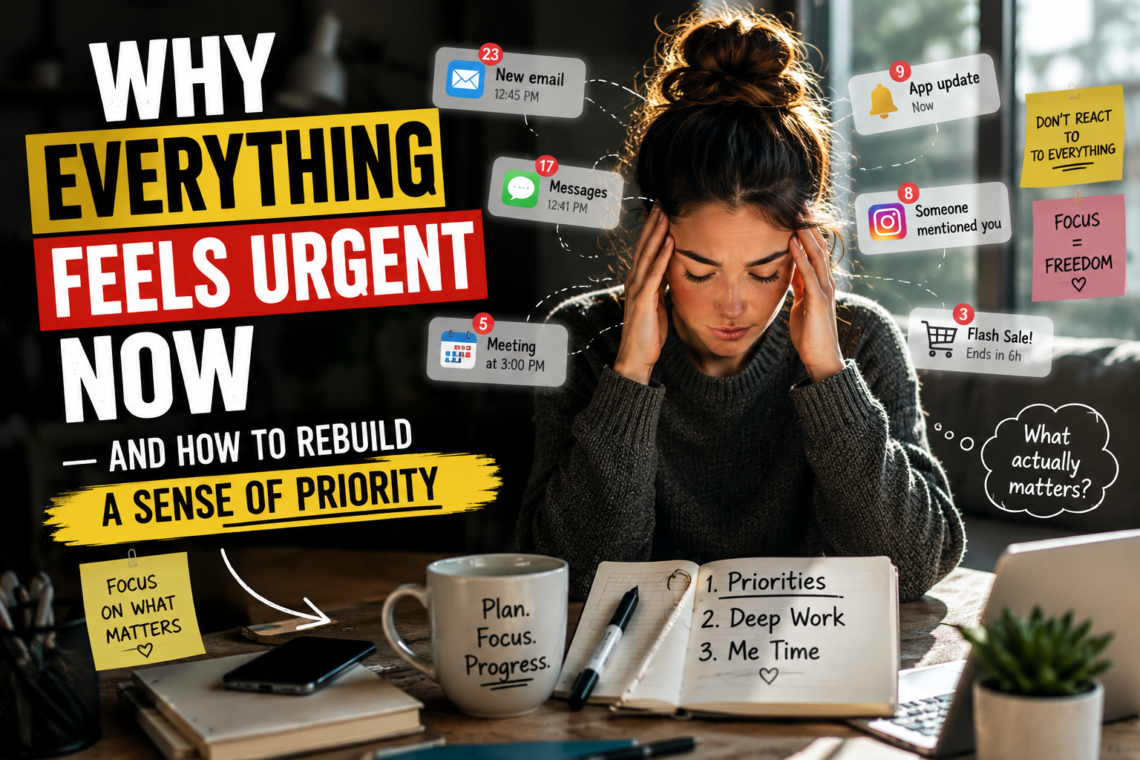
You open your laptop to finish one important task.
Before you begin, an email arrives.
Then your phone lights up.
A message needs an answer. A delivery notification appears. Someone comments on something you posted three days ago. Your calendar reminds you about tomorrow. An app announces an update. A website tells you there are only six hours left to claim a discount you never knew existed.
Ten minutes later, you have responded to three things, opened seven tabs, remembered two unrelated tasks, and completely forgotten what you originally sat down to do.
Nothing dramatic happened.
Yet somehow, your brain feels as if it has already dealt with a minor emergency.
This is one of the strangest features of modern life: everything seems to arrive with the emotional tone of urgency.
The problem is not simply that we have too much to do.
It is that our brains are increasingly being asked to decide, hundreds of times a day:
Does this need my attention right now?
And when everything is presented as immediate, important, new, or time-sensitive, our ability to recognize what actually matters begins to weaken.
Urgent Is Not the Same as Important
Urgent things demand attention.
Important things deserve attention.
Those are not always the same.
A notification may be urgent because it appears immediately.
A long-term project may be important even though nobody is reminding you about it.
An email can feel urgent because someone else sent it five minutes ago.
Going for a walk may be more important for your day, even though your phone will never vibrate to tell you:
“Your brain would benefit from twenty minutes outside.”
This creates a strange imbalance.
The things shouting the loudest often receive our attention first, while quieter priorities are repeatedly postponed.
The report that could improve your career waits.
The book you wanted to read waits.
The conversation you wanted to have waits.
The exercise you planned waits.
The personal project you keep saying matters to you waits.
Meanwhile, your attention gets consumed by things that happened to arrive more noisily.
The Modern World Is Extremely Good at Creating Artificial Urgency
Urgency used to mean something was genuinely time-sensitive.
Now it is also a design strategy.
Think about the phrases you encounter online:
Only 2 left.
Offer ends tonight.
Someone mentioned you.
You have 7 unread messages.
Your streak is about to expire.
Flash sale.
Breaking news.
Respond now.
Don’t miss out.
None of these messages are necessarily malicious. Some are genuinely useful.
But together they create an environment where your nervous system receives a constant stream of miniature signals saying:
Pay attention. Something is happening.
The brain does not always have time to carefully evaluate whether each signal deserves attention.
So it reacts first.
That reaction may last only a second, but repeat it fifty times and you begin to understand why a day spent sitting at a desk can feel surprisingly exhausting.
The Hidden Cost of Constant Urgency
The biggest cost is not simply wasted time.
It is fragmented attention.
Imagine you are trying to write something difficult.
You finally reach the point where your thoughts begin connecting. You understand where the paragraph is going. The problem starts becoming clearer.
Then a message appears.
You check it for twenty seconds.
When you return, the document is still there.
But your mental position is not.
You need to reconstruct what you were thinking.
Where was I going with this?
What did I want to say next?
Why did that sentence matter?
The interruption may have lasted only seconds, but recovering your previous level of concentration takes longer.
This is why a day filled with tiny interruptions can produce the frustrating feeling:
“I was busy all day, but what did I actually finish?”
You did many things.
You simply spent too little uninterrupted time on any one thing.
Why Small Requests Feel So Difficult to Ignore
There is another reason urgency is powerful.
Responding creates relief.
An unanswered email becomes an open loop.
A notification disappears when you tap it.
A message stops waiting when you reply.
A task feels satisfying when you check it off.
So your brain receives a tiny reward:
Done.
Important work often gives you the opposite experience.
You can work on a major project for ninety minutes and still not finish it.
No notification disappears.
No one congratulates you.
There may not even be a visible result yet.
This creates a dangerous preference for small completion over meaningful progress.
You answer six emails because six completed actions feel more productive than spending an hour thinking deeply about one difficult problem.
The inbox gets cleaner.
Your priorities do not necessarily move forward.
The Urgency Illusion
Try this question:
If I ignored this for three hours, what would actually happen?
You may be surprised by the answer.
For many things:
Nothing.
The message will still exist.
The article will still be available.
The notification will still be there.
The person emailing you will survive.
The online sale may end, which could actually save you money.
A surprising amount of modern urgency is really just immediacy.
Something has arrived now, therefore it feels as though it requires action now.
But arrival time does not determine importance.
Your Inbox Is Someone Else’s To-Do List
This applies particularly strongly to email.
Every new message is essentially someone else placing an item in front of you.
Sometimes that item deserves immediate attention.
Often it does not.
But if you spend your entire day reacting to incoming communication, other people’s priorities slowly become your schedule.
This does not mean ignoring people.
It means deciding when communication gets access to your attention.
There is a huge difference between:
“I respond to email.”
and
“I monitor email continuously.”
The first is a task.
The second is an environment.
And environments shape behavior far more than we realize.
The Three-Level Priority Test
When everything feels important, simplify.
Try dividing incoming tasks into three categories.
1. Actually urgent
Something meaningful will go wrong if you do not act soon.
Examples might include:
A deadline happening today.
An important logistical problem.
A family situation requiring attention.
A customer issue that genuinely cannot wait.
These deserve interruption.
2. Important, but not urgent
This category is where much of life improvement happens.
Exercise.
Learning.
Planning.
Deep work.
Relationship maintenance.
Financial organization.
Creative projects.
Career development.
Rest.
Nobody usually demands that you do these today.
That is exactly why they are easy to postpone.
3. Neither urgent nor particularly important
Many notifications live here.
Minor updates.
Low-value messages.
Things you check automatically.
Content you consume because it appeared in front of you.
The goal is not to eliminate everything in this category.
Life does not need to become a military operation.
The goal is simply to stop allowing Category 3 to constantly interrupt Category 2.
Decide Your Priorities Before the Internet Does
One of the easiest ways to lose a day is to start it reactively.
You wake up.
Check your phone.
Open email.
Look at messages.
Read the news.
Suddenly your brain is full of other people’s requests, problems, opinions, and updates before you have decided what matters to you.
Instead, try identifying one meaningful priority before opening the floodgates.
Ask:
If I complete only one meaningful thing today, what should it be?
Not ten things.
One.
Your day may contain dozens of tasks, but one clear priority gives your attention an anchor.
When interruptions appear, you have something to compare them against.
Does this deserve to replace what I decided mattered today?
Sometimes yes.
Usually no.
Create Office Hours for Your Notifications
You do not need to disappear from society.
You simply need boundaries.
Instead of checking email continuously, try checking it at specific times.
Instead of responding to messages every few minutes, create small communication windows.
For example:
Morning check.
Midday check.
Late afternoon check.
The exact schedule does not matter.
The principle does.
You are changing communication from something that interrupts you into something you intentionally visit.
That small distinction can dramatically change how a workday feels.
Turn Off Notifications That Do Not Represent Emergencies
A useful question for every notification is:
If I do not see this immediately, is there a real consequence?
If the answer is no, it probably does not need permission to interrupt you.
Social media likes?
Probably not.
Shopping offers?
Definitely not.
News updates?
Usually not.
Random app suggestions?
Almost certainly not.
You can still use these services.
You simply decide when.
Attention works differently when you choose where to place it instead of repeatedly having it captured.
Make Important Things More Visible
Urgent things are good at reminding you they exist.
Important things are often terrible at it.
So give them help.
Put your book on your desk.
Leave your walking shoes somewhere visible.
Keep the project document open.
Write your main priority on paper.
Schedule exercise.
Place your notebook beside your computer.
Make the things you claim matter physically or digitally visible.
If your important goals are hidden inside a folder while distractions are sending notifications every five minutes, the competition is not exactly fair.
Use the “Tomorrow Test”
When something feels urgent, ask:
Will this still matter tomorrow?
If yes, it may deserve attention.
If not, consider whether it deserves much attention today either.
This is especially useful for online controversies, trending topics, minor frustrations, and random pieces of information that suddenly feel incredibly important because everyone is talking about them.
The internet has an extraordinary ability to make temporary things feel permanent.
Twenty-four hours later, many have disappeared completely.
Protect the First Hour of Focus
If possible, give yourself one period each day where nothing gets to become urgent unless it truly is.
Maybe forty-five minutes.
Maybe ninety.
Phone away.
Email closed.
Notifications off.
One task.
This does not sound revolutionary.
That is precisely why it works.
Deep focus has become rare not because it requires complicated technology, but because uninterrupted time has become unusual.
A protected hour can sometimes accomplish more meaningful work than an entire reactive afternoon.
Not Everything Needs an Immediate Answer
There is also a social habit worth unlearning:
The belief that being reachable means being available instantly.
Fast replies are convenient.
They are not always necessary.
You can be reliable without responding within sixty seconds.
You can care about people without living inside your messaging apps.
You can be professional without allowing email to determine every transition in your day.
Sometimes the healthiest response time is simply:
Later.
Your Brain Needs Quiet Priorities
Constant urgency creates a life where you are always moving but rarely choosing the direction.
That is the deeper issue.
Productivity is not about reacting faster.
It is about becoming more selective about what deserves your limited attention.
Because attention is limited.
There will always be another message.
Another notification.
Another article.
Another update.
Another sale.
Another request.
Another thing somebody wants you to notice.
You cannot respond to everything.
So the skill is not keeping up.
The skill is deciding what deserves to be left behind.
A Simple 24-Hour Experiment
Tomorrow, try this:
Before checking messages in the morning, write down your three most important things.
Choose one as your main priority.
Turn off non-essential notifications for a few hours.
Check email at designated times rather than continuously.
Whenever something suddenly feels urgent, ask:
“What happens if this waits?”
At the end of the day, notice something more interesting than how many tasks you completed.
Ask: Did my attention go where I actually wanted it to go?
That question may be more useful than any productivity score.
Final Thought
The world will probably not become quieter.
Apps will keep sending notifications.
People will keep sending messages.
Companies will keep creating countdown timers.
There will always be something new demanding your attention.
The goal is not to escape all of it.
The goal is to develop a stronger internal definition of what matters now.
Because when everything feels urgent, nothing truly has priority.
And sometimes the most productive thing you can do is simply look at everything demanding your attention and decide:
Not yet.