

You’re Doing Nothing. So Why Are You Tired?
You’re sitting on the sofa.
Technically, you’re resting.
No laptop. No meeting.
No urgent task in front of you.
Maybe you’re drinking coffee. Maybe you’re watching something. Maybe you’re staring peacefully at the ceiling pretending you’ve finally mastered work-life balance.
And yet your brain is doing this:
I need to reply to that email.
We’re almost out of toothpaste.
Did I pay that bill?
I should really organize those photos.
I still haven’t replied to Sam.
I need to book that appointment.
What was that thing I needed to remember?
Wait.
What was the thing?
Now you’re trying to remember the thing you were worried about forgetting.
Congratulations.
You’re resting.
Physically, perhaps.
Mentally?
Your brain appears to be running a small logistics company with no employees.
This is what I call the invisible to-do list.
It isn’t necessarily written anywhere.
It doesn’t have checkboxes.
You may not even consciously know everything that’s on it.
But it’s there.
And sometimes it can make an ordinary Tuesday feel strangely exhausting.
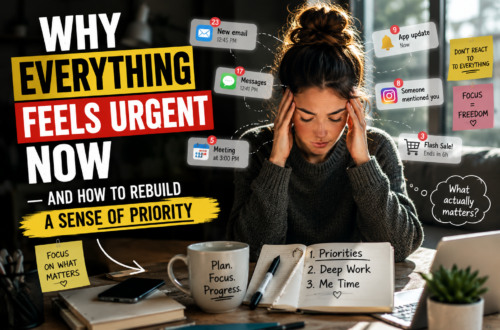
Your Brain Has More Tabs Open Than Your Browser
Imagine opening your laptop and launching a browser.
You open your email.
Then a document.
Then an article.
Then another article.
Then a shopping page.
Then a calendar.
Then a video.
Then something you promise yourself you’ll read later.
Three hours later, you look at the top of your browser and discover 27 tabs.
You don’t need all 27 right now.
But you hesitate to close them.
Why?
Because each tab represents something unfinished.
« I’ll need that later. »
Our minds can work in a surprisingly similar way.
Every unresolved task can become a little mental tab:
Reply to message
Make appointment
Research insurance
Fix cabinet
Call family member
Finish presentation
Decide where to go this weekend
Cancel trial before it charges you
Individually, none of these things may be particularly difficult.
Together, they create noise.
The problem isn’t always the amount of work.
Sometimes it’s the amount of unfinishedness.
Meet the Open Loop
Psychologists have long studied our tendency to remember unfinished or interrupted tasks.
One concept often discussed in this context is the Zeigarnik effect, named after psychologist Bluma Zeigarnik.
The simplified popular interpretation is that unfinished tasks can remain mentally salient because your brain hasn’t yet received the satisfying signal:
Done.
But it’s important not to turn this into internet mythology.
Your brain isn’t literally keeping a perfect hidden checklist of every unfinished task, and the psychology of memory, attention, stress and goal pursuit is more complicated than one effect.
Still, the everyday experience is familiar.
Start something important.
Don’t finish it.
Walk away.
And sometimes it follows you.
Not physically.
That would be terrifying.
Mentally.
Tiny Tasks Can Feel Surprisingly Heavy
Here’s the strange part.
The invisible to-do list isn’t necessarily dominated by huge projects.
Sometimes it’s full of ridiculous little things.
Buy batteries.
Return package.
Change password.
Send photo.
Download invoice.
Book haircut.
Replace light bulb.
Check bank statement.
Find that document.
Cancel subscription.
None of these tasks should consume your entire afternoon.
But because they’re unresolved, they keep reappearing.
« Don’t forget me. »
And your brain replies:
« I won’t. »
Then another task arrives.
« Don’t forget me either. »
« Fine. »
Another.
« Hello. »
« Oh, come on. »
Eventually your mind is trying to act as a calendar, reminder system, task manager, filing cabinet and personal assistant simultaneously.
Your brain is extraordinary.
But maybe we don’t need to make it remember dishwasher tablets.
The Difference Between Workload and Mental Load
Suppose two people each have ten things to do.
Person A has all ten tasks written down, knows when they’ll handle them, and understands which ones matter today.
Person B is trying to remember all ten mentally.
Same number of tasks.
Very different experience.
This is why mental busyness doesn’t always correspond perfectly with actual workload.
You can have relatively little to do and still feel overwhelmed because everything feels unresolved.
Conversely, you can have a busy week and feel surprisingly calm when you know exactly what’s happening.
Clarity reduces friction.
Uncertainty multiplies it.
Why “I’ll Remember It” Is a Terrible Productivity System
We’ve all done this.
You’re in the shower and suddenly remember something important.
« I need to send that document tomorrow. »
You don’t have your phone.
No notebook.
No computer.
So you make a deal with your brain:
Remember this.
Your brain agrees.
Later, you’re eating lunch.
You feel uneasy.
There’s something you were supposed to remember.
Something important.
Something…
Gone.
Your brain has betrayed the contract.
The problem is that human memory wasn’t designed to function like a perfect notification system.
We’re much better off capturing commitments externally when possible.
A trusted external system tells the brain:
You don’t need to keep reminding me. I’ve stored it somewhere safe.
That can be remarkably relieving.
The Most Dangerous Phrase: “I Need to…”
Pay attention to your thoughts for one day.
Notice how often this phrase appears:
I need to…
I need to exercise.
I need to answer that person.
I need to clean that room.
I need to learn this.
I need to fix that.
I need to research something.
I need to get organized.
Each statement creates a small psychological commitment.
But many of them are vague.
And vague tasks are particularly annoying.
Consider:
“Deal with finances.”
What does that mean?
Pay a bill?
Review spending?
Call the bank?
Create a budget?
Search for a missing receipt?
Compare insurance?
Your brain sees one task.
But hidden inside it may be seven decisions.
That’s why vague items often remain on to-do lists forever.
They aren’t tasks.
They’re clouds.
Your Brain Hates Clouds
Compare:
Organize office
with:
Put the loose documents on the desk into the filing drawer.
The second one is actionable.
You know where to begin.
Compare:
Get healthier
with:
Take a 20-minute walk after lunch tomorrow.
Compare:
Plan vacation
with:
Choose three possible destinations and send them to my partner tonight.
Compare:
Fix website
with:
Replace the broken image on the About page.
The more concrete the next action becomes, the less mysterious the task feels.
Sometimes overwhelm isn’t saying:
“There’s too much to do.”
It’s saying:
“I don’t know what doing this actually means.”
Why Rest Doesn’t Always Feel Like Rest
This is where things become particularly interesting.
You finally stop working.
You sit down.
But mentally, you haven’t closed anything.
You’re thinking about tomorrow.
Replaying a conversation.
Remembering tasks.
Anticipating problems.
Making decisions.
Trying not to forget something.
This can make passive leisure feel strangely unsatisfying.
You watch an episode of something but barely remember it.
You scroll your phone while thinking about work.
You lie in bed mentally negotiating with Thursday.
You are technically not working.
But your attention hasn’t fully left work either.
That’s why genuine rest often requires more than simply stopping activity.
It can require giving the mind enough confidence that unfinished things will still be there when you return.
The 15-Minute Brain Unload
Here’s the practical part.
Don’t reorganize your entire life.
Don’t download six applications.
Don’t buy a productivity planner with 14 different sections.
Take a piece of paper.
Or open one blank document.
Set a timer for 15 minutes.
Then write down everything that’s occupying mental space.
Don’t organize it yet.
Just unload it.
It might look like this:
Email David
Dentist appointment
Renew insurance
Finish article
Buy cat food
Fix kitchen drawer
Call bank
Birthday gift
Back up photos
Reply to WhatsApp message
Check passport expiry
Cancel free trial
Read document
Book train
Replace charger
Clean desktop
Research course
Send invoice
Keep going.
Include stupid things.
Especially stupid things.
If your brain has spent energy remembering:
Buy olive oil
then olive oil deserves its moment on the page.
Something Strange May Happen
At first, you’ll write obvious tasks.
Then you’ll slow down.
Then another one appears.
« Oh! That. »
Write it.
Then another.
And another.
You may discover that the feeling of having « a million things to do » is actually 23 specific things.
Twenty-three is still work.
But it’s finite.
That’s psychologically different from:
EVERYTHING.
Your brain likes to turn uncertainty into infinity.
Writing things down gives infinity edges.
Step Two: Don’t Do Everything
This is important.
After completing the brain unload, you may feel an irresistible urge to immediately tackle all 23 items.
Don’t.
The goal isn’t to create a punishment list.
Now we’re going to reduce it.
Mark each item with one of four decisions:
DO
SCHEDULE
DROP
DELEGATE
That’s it.
DO — It Actually Needs Action
These are legitimate commitments.
But don’t simply leave them vague.
Turn each into a clear next step.
Instead of:
Taxes
write:
Download last month’s bank statement.
Instead of:
Website
write:
Rewrite About page introduction.
Now the task has a starting point.
SCHEDULE — Not Everything Belongs to Today
This category is powerful.
A task may matter without mattering now.
If you know you’ll handle something Friday at 10 a.m., your brain doesn’t need to repeatedly ask:
« Should we do this now? »
You’ve already answered.
No.
Friday.
10 a.m.
Next.
DROP — The Most Underrated Productivity Technique
Some things on your mental to-do list don’t need to be completed.
They need to be abandoned.
Maybe you intended to read an article three months ago.
Maybe you planned to start a hobby you’re no longer interested in.
Maybe there’s a project you’ve been carrying around because Past You thought Future You should want it.
Ask:
If I never did this, what would actually happen?
Sometimes the answer is:
Nothing.
Delete it.
There is enormous relief in consciously deciding not to do something.
An abandoned task is very different from an indefinitely postponed task.
One is closed.
The other keeps knocking.
DELEGATE — You Are Not Automatically the Person
Some tasks exist on your list simply because you happened to notice them.
That doesn’t necessarily make them yours.
Could someone else handle it?
Could it be automated?
Could responsibility be shared?
Could you ask for help?
Productivity culture often celebrates doing everything yourself.
Actual productivity sometimes looks like:
“This doesn’t require me.”
The Two-Minute Trap
You may have heard advice suggesting that if something takes less than two minutes, you should do it immediately.
That can be useful.
It can also become a fantastic way to avoid difficult work.
You sit down to write something important.
Then:
I’ll quickly answer this email.
I’ll quickly put this away.
I’ll quickly update that.
I’ll quickly check something.
Forty-five minutes later, you’ve become the world champion of insignificant tasks while the important project remains untouched.
Quick doesn’t automatically mean important.
Use tiny tasks to clear friction when appropriate.
Don’t let them become sophisticated procrastination.
The Sunday-Night Phenomenon
There’s a reason unresolved commitments often become louder during quiet moments.
During a busy day, new stimuli constantly occupy attention.
Then evening arrives.
Or Sunday night.
Or you’re trying to sleep.
Suddenly:
« HELLO. REMEMBER EVERYTHING? »
Your brain finally has enough silence for unfinished concerns to surface.
This is why a short end-of-day or end-of-week review can be so valuable.
Not because you’re trying to optimize every second of your existence.
Because you’re telling your brain:
I’ve looked at the situation. There is a plan. You can stop shouting.
Try the Shutdown Sentence
At the end of your workday, spend five minutes checking:
What remains unfinished?
What needs attention tomorrow?
Is anything important still only in my head?
Then write tomorrow’s first meaningful task.
Finally, mentally declare work finished.
You can even use a sentence:
“Everything important is captured. Tomorrow has a starting point. I’m done for today.”
Does this magically erase every thought about work?
Of course not.
But rituals can create boundaries.
And modern work desperately needs boundaries.
The Invisible List Includes Decisions Too
Tasks aren’t the only things consuming mental space.
Unmade decisions can be even worse.
Should I buy this?
Should I accept that invitation?
Should I change jobs?
Which course should I choose?
Should I repair this or replace it?
Where should we travel?
What should I cook?
Should I respond?
The brain keeps revisiting unresolved decisions because the question remains open.
Sometimes the best productivity move isn’t doing something.
It’s deciding something.
Even deciding:
“I’m not deciding this until next Tuesday.”
can create relief.
You’ve closed the decision temporarily.
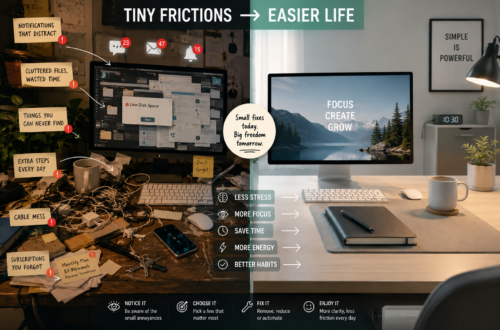
Digital Clutter Creates Mental Clutter Too
Look at your digital environment.
47 browser tabs.
2,184 unread emails.
Screenshots you don’t remember taking.
Documents named:
final
final2
final_new
final_ACTUAL
final_ACTUAL_USE_THIS_ONE
Notifications everywhere.
Downloads folder resembling an archaeological excavation.
Digital clutter isn’t identical to mental clutter, but it can constantly remind you of unresolved information.
You don’t need digital minimalism perfection.
Just remove obvious friction.
Close tabs you don’t need.
Archive irrelevant email.
Delete downloads you’re finished with.
Put important files somewhere predictable.
Your computer doesn’t need to look like a Scandinavian furniture catalog.
It just shouldn’t make you anxious when you open it.
The “One Trusted Place” Rule
The brain unload works only if you trust where the tasks go afterward.
If you write things on:
three notebooks,
two apps,
sticky notes,
email drafts,
your hand,
and one mysterious piece of paper somewhere in the kitchen…
your brain won’t relax.
Because it knows the system is unreliable.
Choose one main place for actionable tasks.
It doesn’t matter whether it’s sophisticated.
A notebook works.
A basic task app works.
A simple document works.
The best system is the one you actually check.
Here’s the Real Goal
The goal isn’t to empty your brain.
That’s impossible.
And probably undesirable.
The goal is to stop using your attention to repeatedly rehearse information that could live somewhere else.
Your mind should be available for:
Thinking.
Creating.
Solving problems.
Learning.
Talking to people.
Not repeatedly whispering:
« Dishwasher tablets. »
A 7-Day Invisible To-Do List Challenge
Want to test whether this actually helps?
Try this for seven days.
Day 1 — Unload
Spend 15 minutes writing down everything occupying your mind.
Day 2 — Clarify
Turn vague projects into specific next actions.
Day 3 — Delete
Find at least three commitments you can consciously abandon.
Day 4 — Schedule
Move non-urgent tasks out of mental limbo and give them a date.
Day 5 — Close Digital Loops
Close unnecessary tabs, clean one messy digital location, and remove useless notifications.
Day 6 — Practice Real Rest
Take 30 minutes without trying to be productive.
No optimization.
No « productive relaxation. »
Just rest.
Observe how difficult or easy it feels.
Day 7 — Review
Ask:
What kept returning to my mind this week?
What disappeared once I wrote it down?
Which tasks weren’t actually important?
What still feels unresolved?
You’ve now learned something far more useful than whether a particular productivity app works.
You’ve learned what your brain keeps trying to protect you from forgetting.
What If Your List Is Huge?
Don’t panic.
A large list isn’t automatically bad news.
Remember:
Those tasks already existed.
Writing them down didn’t create the workload.
It revealed it.
Now you can make decisions.
Some tasks will be completed.
Some scheduled.
Some delegated.
Some abandoned.
And some will reveal larger problems that deserve attention.
Visibility gives you options.
Invisible overwhelm doesn’t.
You Don’t Need to Finish Everything to Feel Better
This may be the most important point in the entire article.
Relief doesn’t always come from completing everything.
That’s unrealistic.
Sometimes relief comes from knowing what everything is.
There’s a huge difference between:
« I have so much to do. »
and:
« I have 18 things captured. Three matter this week. Two can be delegated. Six can wait. Four aren’t important anymore. I’ll handle the rest later. »
The workload may be almost identical.
The mental experience isn’t.
Your Brain Is for Thinking, Not Storage
We often treat memory like a moral test.
If something matters, surely we should remember it.
But there is nothing noble about using mental energy to remember:
Buy detergent.
Send attachment.
Renew subscription.
Call dentist.
Modern life generates too many small commitments for that.
Write them down.
Let technology remember dates.
Let calendars remember appointments.
Let task lists remember tasks.
Let your brain do the thing it’s much better at:
thinking about what matters.
Final Thoughts
Sometimes we feel exhausted because we’ve done too much.
But sometimes we feel exhausted because we’re mentally carrying too many things that haven’t been decided, captured, scheduled, completed or consciously abandoned.
That’s the invisible to-do list.
It follows us from work to dinner.
From dinner to the sofa.
From the sofa to bed.
And occasionally into the shower, where it suddenly remembers the one thing we desperately needed to remember yesterday.
You don’t need a perfect productivity system to reduce that noise.
Start with fifteen minutes.
Take a blank page.
Write everything down.
Decide what matters.
Schedule what can wait.
Delete what doesn’t.
Then close the page.
You may still have plenty to do.
But at least your brain no longer has to stand at the door all evening whispering:
“Don’t forget.”
And perhaps that’s what feeling organized really means.
Not having nothing left to do.
But knowing you don’t have to remember everything at once.



That mental clutter is so draining. I found that getting everything out of my head and into a system helps. I use Taskai on my Android to dump all those random thoughts and notifications into reminders so they don’t loop in my brain.
Thanks for sharing! Getting thoughts out of your head and into an external system can definitely reduce that feeling of mental overload. The important part is finding a simple system you trust enough that your brain doesn’t feel the need to keep reminding you of everything. Glad you found something that works for you!