
Focus has become one of the most valuable skills of the modern era.
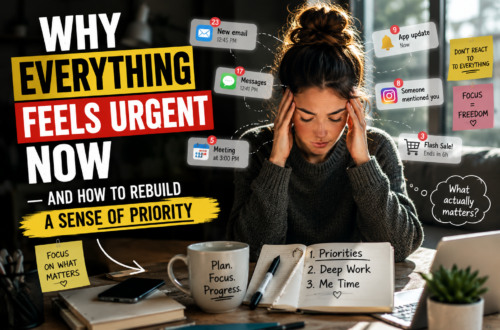
Every day, thousands of notifications, emails, videos, advertisements, and social media updates compete for our attention. Most people don’t realize that their ability to focus is constantly being challenged by systems specifically designed to keep them engaged for as long as possible.
The result is a growing number of people who feel busy all day but accomplish very little.
The problem is not laziness.
The problem is attention.
In today’s economy, attention is a valuable resource. Companies invest billions of dollars every year to capture and retain it. Understanding how this system works is the first step toward regaining control of your time and productivity.
What Is the Attention Economy?
The attention economy is the idea that human attention is a limited resource.
Every platform, app, website, and digital service wants a share of that resource. Since people only have a finite number of hours in a day, companies compete aggressively to keep users engaged.
Think about how many times you check your phone daily.
Most people do it without conscious intention. A quick glance turns into several minutes of scrolling. A simple notification leads to another video, another article, and another distraction.
These moments may seem small, but they accumulate over weeks, months, and years.
The attention economy thrives on these tiny interruptions.
Why Constant Distractions Are Dangerous
Many people underestimate the cost of switching attention.
Research consistently shows that when you interrupt a task, your brain needs time to regain full concentration.
Imagine writing an important report.
A notification appears.
You check a message.
You return to work.
Although the interruption lasted only a few seconds, your brain may need several minutes to fully return to the same level of focus.
Multiply this process dozens of times per day and the productivity loss becomes enormous.
The consequences include:
- Reduced work quality
- Increased stress
- Mental fatigue
- Poor memory retention
- Lower creativity
- Longer working hours
Many professionals mistakenly believe they are multitasking efficiently when they are actually fragmenting their attention.
The Hidden Cost of Being Always Connected
Technology has brought incredible advantages.
Communication is faster than ever. Information is available instantly. Remote work and online learning have created opportunities that were unimaginable a generation ago.
However, constant connectivity comes with hidden costs.
When people never disconnect, their brains rarely experience periods of deep concentration.
Instead of focusing on one meaningful activity, they continuously jump between tasks.
This state of constant partial attention creates a feeling of busyness without genuine progress.
Many people finish the day exhausted while struggling to identify what they actually accomplished.
Deep Work: The Skill of the Future
One of the most valuable concepts for modern productivity is deep work.
Deep work refers to periods of uninterrupted concentration dedicated to cognitively demanding tasks.
Examples include:
- Writing
- Programming
- Designing
- Researching
- Learning complex skills
- Strategic planning
During deep work sessions, distractions are minimized and attention remains fully directed toward a single objective.
People who regularly practice deep work often produce higher-quality results in less time than those who constantly multitask.
As artificial intelligence and automation continue to evolve, the ability to perform deep, focused thinking may become even more valuable.
Signs That Your Attention Is Being Hijacked
Many individuals do not realize how frequently their focus is interrupted.
Common warning signs include:
- Checking your phone without a specific reason
- Opening multiple browser tabs simultaneously
- Switching tasks every few minutes
- Feeling uncomfortable during quiet moments
- Frequently rereading the same paragraph
- Forgetting what you were working on
- Constantly seeking new stimulation
If several of these habits sound familiar, your attention may be under continuous pressure.
The good news is that attention can be trained and strengthened.
Practical Ways to Protect Your Focus
Create Notification-Free Zones
Not every notification deserves immediate attention.
Disable non-essential alerts and reserve specific times for checking messages.
Many people discover that most notifications provide little real value while causing significant interruptions.
Use Time Blocks
Instead of working reactively, schedule dedicated blocks of focused work.
For example:
- 9:00–10:30: Deep work
- 10:30–11:00: Emails
- 11:00–12:30: Project work
This structure reduces decision fatigue and helps maintain concentration.
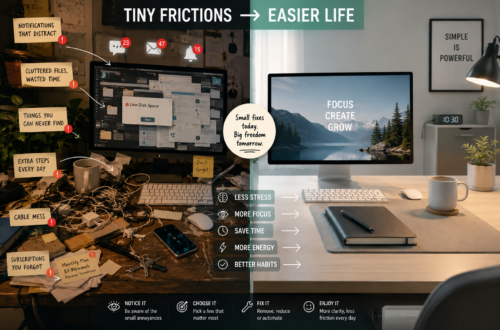
Keep Your Workspace Simple
Visual clutter often creates mental clutter.
A clean environment makes it easier to focus on important tasks.
Remove unnecessary distractions from your desk and keep only the tools required for your current work.
Learn to Be Bored Again
Modern technology provides constant stimulation.
Many people immediately reach for their phones whenever they experience a few seconds of boredom.
However, creativity often emerges during moments of mental silence.
Allow yourself occasional periods without entertainment, notifications, or digital input.
Your brain needs these moments to process information and generate new ideas.
The Role of Sleep in Attention
Focus is impossible without adequate rest.
Sleep directly affects:
- Memory
- Decision-making
- Emotional regulation
- Learning
- Concentration
Many productivity problems are actually sleep problems in disguise.
Improving sleep quality can often generate greater productivity gains than downloading another app or adopting another productivity system.
Prioritize consistent sleep schedules whenever possible.
Why Focus Is Becoming a Competitive Advantage
As distractions increase, focused individuals become increasingly rare.
This creates an interesting opportunity.
The ability to concentrate deeply for extended periods is becoming a competitive advantage in nearly every field.
Whether you are a student, entrepreneur, freelancer, creator, or employee, focus enables you to:
- Learn faster
- Produce better work
- Solve complex problems
- Make smarter decisions
- Achieve meaningful goals
In a distracted world, concentration becomes a superpower.
Building a Sustainable Attention System
Protecting your attention is not about eliminating technology.
It is about using technology intentionally.
Ask yourself:
- Does this activity help me achieve my goals?
- Am I consuming information or creating value?
- Is this distraction worth my attention?
Small daily choices determine where your attention goes.
And where your attention goes, your life follows.
Conclusion
The modern world offers endless opportunities, but it also presents endless distractions.
Companies compete for your attention because attention is valuable. The more aware you become of this reality, the easier it becomes to make intentional decisions about how you spend your time.
Productivity is not about doing more things.
It is about directing your attention toward the things that matter most.
The people who learn to protect their focus today will have a significant advantage tomorrow.
Because in the attention economy, your greatest asset is not your time.