My Phone Wasn’t the Problem. Or So I Thought.
I didn’t consider myself addicted to notifications.
That was my first mistake.
I wasn’t the person who jumped across the room every time a phone vibrated. I didn’t have hundreds of unread messages. I wasn’t consciously checking social media every thirty seconds.
At least, that’s what I told myself.
Then one ordinary afternoon, while trying to finish a relatively simple piece of work, I noticed something strange.
My phone lit up.
I looked.
Nothing important.
A few minutes later, my computer displayed an email notification.
I looked.
Not urgent.
Then my phone vibrated again.
Someone had reacted to something.
I checked it.
And because I was already holding the phone, I opened another app.
Then another.
Eventually I put the phone down.
I looked back at my computer.
And had absolutely no idea what sentence I had been writing.
That was the moment I started wondering:
How much of my attention was being controlled by things I hadn’t consciously decided to look at?
So I decided to run an experiment.
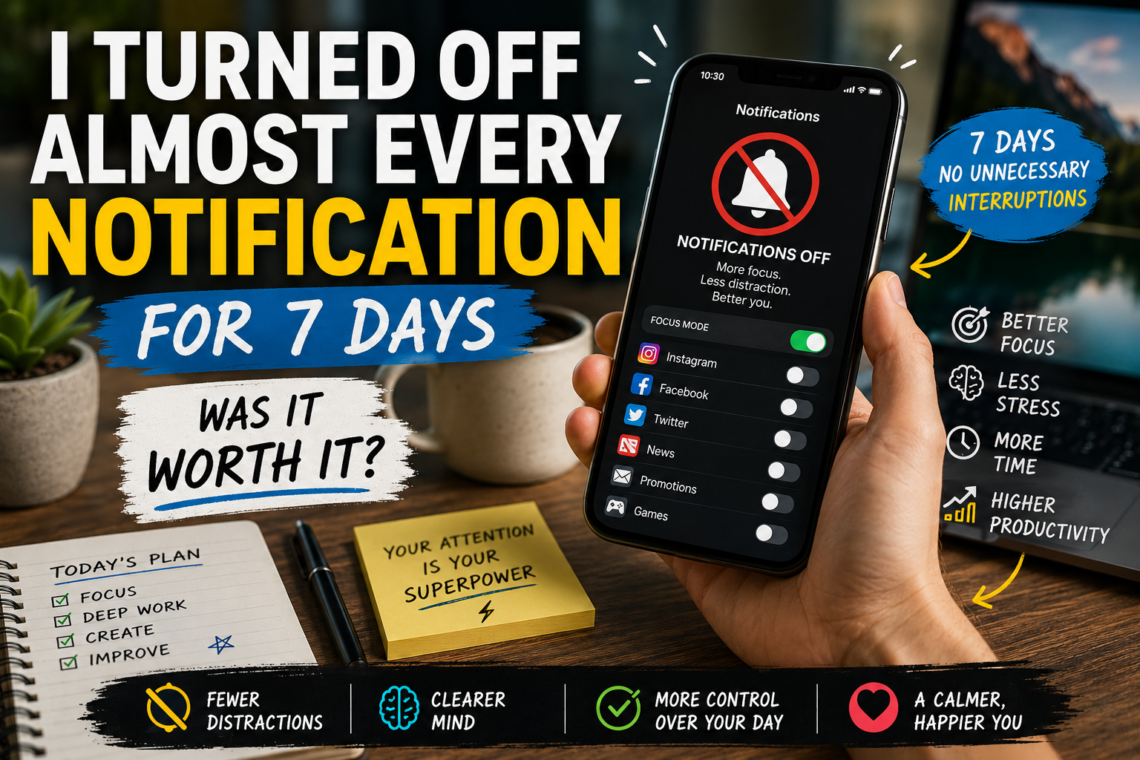
For seven days, I would turn off almost every non-essential notification on my phone and computer.
No social media alerts.
No news notifications.
No promotional messages.
No random app reminders.
No badges desperately informing me that somewhere, somehow, something had happened.
I kept only genuinely important communication and essential system or security alerts.
Everything else would have to wait until I decided to check it.
I expected the experiment to make me slightly more productive.
What I didn’t expect was how weird the first few days would feel.
The Rules of My 7-Day Notification Experiment
Before starting, I needed some rules.
Otherwise, « turning off notifications » could easily become turning them back on the moment I got bored.
My rules were simple:
Rule 1: Almost all non-essential push notifications were disabled.
Rule 2: Calls and genuinely important personal communication stayed available.
Rule 3: Security alerts, authentication requests, calendar reminders I genuinely needed, and other essential notifications remained enabled.
Rule 4: I could still open any app whenever I wanted.
This wasn’t a digital detox.
I wasn’t trying to pretend smartphones didn’t exist.
The experiment was specifically about one thing:
Who initiates the interaction?
Normally, the app says:
« Look at me. »
During this experiment, I wanted to be the one saying:
« I’m choosing to look now. »
That distinction seemed tiny.
It wasn’t.
Day 1 — The Phantom Notification Problem
The first morning felt wonderfully peaceful.
No unnecessary alerts.
No little red circles demanding attention.
No news app telling me something « BREAKING » had happened somewhere.
I sat down to work.
About twenty minutes later, I reached for my phone.
Nothing.
I put it down.
Ten minutes later, I reached again.
Nothing.
Then I did it again.
That’s when the experiment became interesting.
My phone wasn’t interrupting me anymore. I was interrupting myself.
I had assumed notifications were responsible for most of my checking behavior.
Apparently, my brain had learned the routine so well that the notifications were no longer necessary.
Phone nearby?
Check it.
Tiny pause?
Check it.
Difficult sentence?
Check it.
Waiting three seconds for something to load?
Obviously this is an excellent opportunity to check the entire internet.
It was almost comical.
At one point, I picked up my phone, unlocked it, stared at the screen and realized:
I had no reason whatsoever for opening it.
Nothing had happened.
Nobody had summoned me.
My hand had simply performed the movement automatically.
That was probably the most important discovery of Day 1.
Notifications weren’t the entire problem.
They had helped create a habit.
And now the habit could operate independently.
Day 1 verdict
Focus: Slightly better
Urge to check phone: Extremely high
Important things missed: None
Unexpected discovery: My thumb apparently has its own agenda.
Day 2 — Silence Started Feeling Suspicious
On the second day, something unexpected happened.
I started wondering whether I had missed something.
Maybe there was an important email.
Maybe someone had sent me a message.
Maybe something had happened.
The phone was suspiciously quiet.
So I checked.
Nothing urgent.
An hour later, the same thought appeared.
« Maybe I should check. »
Again, nothing important.
This revealed another layer of the notification habit.
Notifications don’t only interrupt us.
They also train us to expect interruption.
When interruption disappears, the absence itself can feel unusual.
It’s similar to living beside a noisy road and suddenly experiencing silence.
The silence should feel peaceful.
Instead, your brain initially asks:
« Why is it so quiet? »
I Didn’t Miss Information — I Received It Later
This was an important distinction.
Turning off notifications did not mean messages disappeared.
Emails still existed.
Social media still existed.
News still existed.
The only thing that disappeared was the assumption that I needed to know about everything the moment it happened.
That’s a surprisingly powerful difference.
A message arriving at 10:17 doesn’t necessarily need to be read at 10:17.
Sometimes 11:30 is perfectly fine.
A new article doesn’t become useless because I discovered it two hours later.
And I definitely don’t need to know immediately that an app has a « special offer selected just for me. »
I’m willing to take that risk.
Day 2 verdict
Focus: Better
Anxiety about missing something: Noticeable
Actually missed: Almost nothing
Lesson: Urgent and immediate are not synonyms.
Day 3 — I Finished Something Without Checking My Phone
Day 3 produced the first moment when the experiment felt genuinely useful.
I started a task.
I worked.
I encountered a difficult section.
Normally, this is exactly where distraction enters.
Difficult work creates friction.
The brain wants relief.
And the phone offers an entire universe of effortless relief approximately 40 centimeters away.
But this time, the phone wasn’t flashing or vibrating.
I still felt the urge to check it.
But there wasn’t a convenient external excuse.
No notification.
No message preview.
No « I’m only checking because someone contacted me. »
I had to admit that if I opened the phone, I was choosing distraction.
That’s surprisingly uncomfortable.
So I didn’t.
I kept working.
And eventually I finished the task.
Nothing dramatic happened.
There was no inspirational music.
Nobody applauded.
I simply finished something faster because I didn’t leave it twelve times.
And that felt strangely satisfying.
The Real Cost Wasn’t the 20-Second Check
This became increasingly obvious.
Checking a notification might take only 20 seconds.
But that’s the wrong measurement.
The real question is:
What happens to your attention afterward?
You see a message.
Now you’re thinking about the message.
You see an email subject.
Now part of your brain is wondering what the email contains.
You see a news headline.
Now you’re thinking about the story.
You see a social notification.
Now you’re inside the app.
One tiny interruption can open a mental door that remains open long after the phone returns to the desk.
Day 3 verdict
Focus: Noticeably improved
Phone checking: Decreasing
Productivity: Better
Biggest realization: Interruptions have an afterlife.
Day 4 — I Started Batching Things Without Planning To
By Day 4, something interesting happened naturally.
Instead of checking things constantly, I started checking them in groups.
Email?
Check several at once.
Messages?
Read several together.
Social media?
Open it intentionally, look around, leave.
I hadn’t created a sophisticated productivity system.
I hadn’t scheduled a beautiful « communication block » in a color-coded calendar.
My brain simply adapted to the absence of constant prompts.
This felt much more efficient.
Imagine doing laundry.
You probably don’t wash one sock every twenty minutes.
You wait.
You accumulate laundry.
Then you process it together.
Yet that’s essentially how many of us handle digital communication.
One message.
Stop.
Respond.
Return.
Another message.
Stop.
Respond.
Return.
Another.
Stop.
You get the idea.
Batching reduced that constant switching.
But I Found One Problem
There was a downside.
Without notifications, it became easier to forget to check certain things entirely.
For unimportant apps, wonderful.
For communication that genuinely mattered, less wonderful.
This is where I realized that the answer wasn’t:
« Notifications are bad. »
The better conclusion was:
« Notifications should earn permission to interrupt me. »
That’s a much more useful rule.
Day 4 verdict
Focus: Strong
Mental clutter: Lower
Communication: More intentional
Problem discovered: Some notifications actually deserve to exist.
Day 5 — The Boredom Test
Day 5 was probably my favorite.
I was waiting somewhere with a few minutes to spare.
Normally:
Phone out.
Unlock.
Scroll.
This time I deliberately didn’t.
And suddenly I had…
nothing to do.
Remember that?
Doing nothing?
It’s an ancient activity.
Very underrated.
I looked around.
People walked past.
I noticed details in the room.
My brain wandered.
An idea related to something I had been working on earlier suddenly appeared.
That moment made me realize how thoroughly smartphones have occupied the tiny empty spaces in our lives.
Elevator?
Phone.
Queue?
Phone.
Waiting for coffee?
Phone.
Commercial break?
Phone.
Friend goes to the bathroom?
EMERGENCY PHONE SESSION.
We’ve become extraordinarily efficient at eliminating boredom.
But I’m not convinced that’s entirely good.
Boredom Isn’t Always the Enemy
When the brain isn’t receiving constant input, it has room to wander.
Sometimes that’s uncomfortable.
Sometimes it’s useless.
And sometimes it’s where ideas appear.
I wouldn’t claim that turning off notifications transformed me into a creative genius by Friday afternoon.
It didn’t.
But I did become more aware of how rarely I allowed my mind to be unstimulated.
Day 5 verdict
Focus: Good
Compulsive checking: Much lower
Boredom: Returned from the dead
Surprise: Boredom wasn’t nearly as terrible as advertised.
Day 6 — I Forgot About My Phone
This sounds exaggerated.
I didn’t literally forget smartphones existed.
But there were periods when I stopped thinking about mine.
That was new.
Previously, the phone had maintained a subtle presence even when I wasn’t using it.
A vibration.
A flash.
A sound.
A badge.
A preview.
A reminder.
An alert.
Tiny signals saying:
« Something is happening over here. »
With most of those signals gone, the phone gradually became more like a tool.
It was available.
But it wasn’t constantly advertising itself.
And this is where the experiment shifted from feeling restrictive to feeling freeing.
During the first days, I thought:
« I’m not allowed to check notifications. »
By Day 6, it felt more like:
« I can check things when I want. »
Those are psychologically very different experiences.
I Still Wasted Time
Important confession.
Turning off notifications did not turn me into a productivity machine.
I still procrastinated.
I still opened things unnecessarily.
I still became distracted.
I still occasionally spent longer online than intended.
That’s important because productivity experiments are often presented as magical transformations.
« I disabled notifications and became 347% more productive! »
No.
Human beings are more complicated than a settings menu.
But removing notifications eliminated one major source of external interruption.
That made the remaining distractions easier to notice.
Day 6 verdict
Focus: Much better
Phone awareness: Lower
Superhuman productivity achieved: Unfortunately not
Control over attention: Definitely improved.
Day 7 — I Didn’t Want the Notifications Back
On the final day, I opened my notification settings again.
The experiment was technically over.
I could turn everything back on.
And something funny happened.
I didn’t want to.
Seeing the long list of apps requesting permission to interrupt me now looked completely different.
Shopping app?
No.
Social media likes?
No.
Random game notification?
Absolutely not.
News alerts?
Mostly no.
Promotional emails?
Please leave me alone.
Calendar?
Yes.
Security?
Yes.
Important communication?
Yes.
A few genuinely useful reminders?
Yes.
The experiment hadn’t convinced me to eliminate notifications.
It had convinced me to become extremely selective about them.
What Actually Changed After Seven Days?
The biggest change wasn’t that I suddenly gained hours of free time.
It was that my days felt less fragmented.
That’s harder to measure but easy to notice.
There were fewer moments where my attention was pulled away without permission.
Tasks felt more continuous.
Reading became easier.
Conversations felt less interrupted.
And my phone felt slightly less important.
Not useless.
Not evil.
Just less important.
Exactly where I think it belongs.
What I Learned About Notifications
1. Not All Notifications Are Equal
A security alert and a social media like should not have the same access to your attention.
Yet by default, they often do.
Treat notifications as permissions.
Ask:
Does this information genuinely need to interrupt me?
If not, disable it.
2. Badges Are Notifications Too
Those little red numbers are remarkably effective.
17 unread.
3 updates.
9 messages.
They create unfinished business.
Even without sound or vibration, they can pull attention.
Removing unnecessary badges made my phone visually calmer.
3. Email Doesn’t Need to Behave Like Instant Messaging
This may depend on your work.
But for many people, every email doesn’t require immediate attention.
If your job requires instant email responses, obviously adapt accordingly.
Otherwise, checking email intentionally can be much less disruptive than receiving a notification for every message.
4. Social Media Notifications Were Almost Never Important
This was the easiest category to eliminate.
Likes.
Recommendations.
Suggested posts.
Someone uploaded something.
Someone reacted to something.
A creator went live.
A platform thinks I haven’t opened it recently enough.
None of this needed immediate attention.
The apps still worked perfectly when I opened them myself.
5. The Phone Wasn’t Entirely Responsible
This was perhaps the most uncomfortable lesson.
Even without notifications, I sometimes checked my phone automatically.
Technology creates triggers.
But eventually, we internalize those triggers.
Fixing the environment helps.
Then we still have to work on the habit.
The Notification System I Would Keep
After the experiment, I wouldn’t choose either extreme.
Not:
EVERYTHING ON
and not:
ABSOLUTELY NOTHING
Instead, I’d divide notifications into three categories.
Category 1 — Interrupt Me
These should be rare.
Examples might include:
Calls from important people
Security alerts
Time-sensitive calendar reminders
Critical work communication, depending on your job
Category 2 — Show Me Later
Useful information that doesn’t deserve immediate attention.
Email is a good example for many people.
You can check it intentionally at appropriate times.
Category 3 — Never Interrupt Me
This category is enormous.
Promotions.
Likes.
Recommendations.
« Someone you may know. »
Game reminders.
Shopping alerts.
Generic news updates.
Apps begging you to return.
These can disappear.
Life continues.
Should You Try This Experiment?
Yes — but you don’t necessarily need seven days.
Try 48 hours.
Turn off every notification that doesn’t genuinely need immediate attention.
Don’t delete your apps.
Don’t change your entire life.
Just remove their ability to summon you.
Then observe.
How often do you check your phone anyway?
Which notifications do you actually miss?
Which ones do you forget ever existed?
Do you finish tasks more easily?
Does your phone feel calmer?
Does silence make you uncomfortable?
The answers may teach you more about your digital habits than another screen-time report.
My Final Verdict: Was It Worth It?
Absolutely.
But not for the reason I expected.
I started this experiment because I wanted fewer distractions.
I ended it thinking much more about ownership of attention.
Notifications seem tiny.
A vibration.
A banner.
A sound.
A little red circle.
But every notification contains an implicit request:
« Stop thinking about that. Think about this instead. »
Sometimes that request is justified.
Most of the time, it isn’t.
Seven days without unnecessary notifications didn’t transform my life.
It did something smaller and, perhaps, more useful.
It made me notice how frequently I had allowed other people, platforms, algorithms, companies and apps to decide what I should pay attention to next.
Now they have to wait.
I’ll check when I’m ready.
And strangely enough, almost everything is still there.