I Thought a Tomato Timer Couldn’t Possibly Change Much
The Pomodoro Technique sounds almost suspiciously simple.
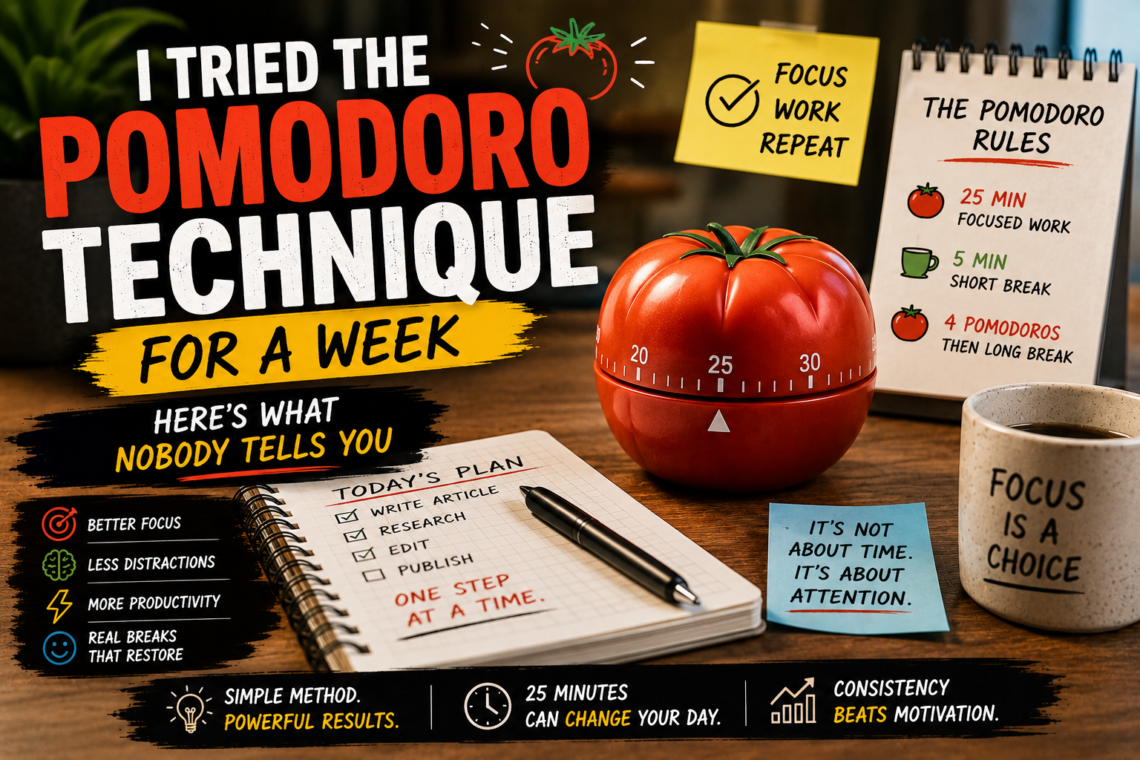
Work for 25 minutes. Take a 5-minute break. Repeat.
After four rounds, take a longer break.
That’s basically it.
No complicated productivity dashboard.
No expensive equipment.
No morning routine involving twelve supplements, an ice bath, and waking up at 4:37 a.m.
Just a timer.
And a tomato.
The name comes from the tomato-shaped kitchen timer Francesco Cirillo used when developing the technique as a university student.
I’d heard about Pomodoro countless times.
People use it for studying, writing, coding, administrative work, reading, and almost anything else requiring concentration.
But I had a question:
Does it actually make you more productive, or does it just make you very aware of every 25 minutes of your life?
So I decided to test the system for seven days.
I expected to learn whether the timer improved my concentration.
Instead, the experiment taught me something much more interesting about procrastination, breaks, unfinished work, and the strange things my brain does when it knows a timer is watching.
The Rules
I wanted to keep the experiment close to the classic version.
One Pomodoro:
25 minutes of focused work
followed by:
5 minutes of rest
After four Pomodoros, I could take a longer break of roughly 15–30 minutes.
During each 25-minute session, I would work on one clearly defined task.
No casually checking email.
No social media.
No « I’ll quickly look this up » unless it was genuinely necessary for the task.
No switching to another project because the current one became uncomfortable.
And, perhaps most importantly:
The timer wasn’t a race.
I wasn’t supposed to type faster because a countdown was happening.
The objective was simply to protect 25 minutes of attention.
Easy.
Or so I thought.
Day 1 — 25 Minutes Felt Much Longer Than Expected
I started the first timer.
25:00.
24:59.
24:58.
Suddenly I became extremely aware that time existed.
For the first few minutes, everything went well.
Then I had an urge to check something unrelated.
Normally, I probably would have done it without thinking.
But now there was a timer on the screen effectively saying:
Nice try. You’re still working.
So I continued.
Then another thought appeared.
I should check my email.
No.
Another.
Maybe I should refill my water.
No.
Another.
I suddenly remembered something completely unrelated that apparently needed my immediate attention despite having been irrelevant for the previous three weeks.
Also no.
That first Pomodoro revealed something uncomfortable:
I wasn’t being distracted only by my phone or computer.
My own brain was generating escape routes.
The Timer Made Procrastination Visible
Without a timer, distraction can be almost invisible.
You start working.
You check something.
You return.
You open another tab.
You return.
You remember something.
You look it up.
Eventually, an hour passes and you feel as if you’ve been working for an hour.
But you haven’t really.
The timer created a boundary.
For 25 minutes, there was only one job.
That made every attempt to escape the job much easier to notice.
Day 1 verdict
Focus: Better than expected
Annoyance with timer: Moderate
Number of imaginary emergencies invented by my brain: Impressive
Main lesson: Distraction often begins internally.
Day 2 — Starting Became Surprisingly Easy
Day 2 revealed what would eventually become my favorite part of Pomodoro.
Starting.
There are tasks that aren’t particularly difficult once you’re doing them.
The difficult part is beginning.
You look at a project and think:
« This is going to take hours. »
Your brain immediately negotiates:
Maybe after coffee.
Maybe after lunch.
Maybe tomorrow.
Maybe after reorganizing the desktop icons alphabetically.
Pomodoro changes the question.
Instead of:
« Can I finish this project? »
the question becomes:
« Can I work on it for 25 minutes? »
That’s much easier to answer.
Yes.
I can survive almost anything for 25 minutes.
The First Pomodoro Was Often Enough
Something interesting happened repeatedly.
I’d resist starting.
I’d promise myself just one Pomodoro.
Then the timer would end.
And by that point, I was already involved in the work.
The psychological obstacle had disappeared.
This made me realize that the technique’s greatest strength might not be concentration at all.
It might be reducing the emotional size of a task.
« Write the report » sounds large.
« Work on the introduction for 25 minutes » sounds manageable.
Day 2 verdict
Starting difficult tasks: Much easier
Focus: Good
Procrastination: Lower
Main lesson: A small commitment can defeat a large task.
Day 3 — The Five-Minute Break Became Dangerous
Work for 25 minutes.
Rest for five.
Simple.
Except five minutes is an extremely dangerous amount of time when the internet exists.
During one break, I checked something on my phone.
I don’t remember exactly what.
That’s the problem.
One thing became another.
Then another.
The five-minute timer ended.
I ignored it.
Eight minutes.
Ten.
Twelve.
My five-minute break had applied for permanent residency.
This exposed a major weakness in the system:
A break is only useful if you can actually end it.
Not All Breaks Are Equal
I began experimenting with different kinds of breaks.
Scrolling social media?
Terrible.
It replaced work stimulation with even more stimulation and made returning harder.
Reading news?
Also terrible.
Checking email?
That’s not a break. That’s just changing jobs.
Standing up?
Good.
Getting water?
Good.
Looking out of a window?
Surprisingly good.
Walking around for a few minutes?
Excellent.
Doing absolutely nothing?
Weird at first, but effective.
The best Pomodoro breaks weren’t entertaining.
They were restorative.
That’s an important difference.
Day 3 verdict
Work sessions: Good
Break discipline: Questionable
Phone during breaks: Bad idea
Main lesson: Your break can destroy your next focus session.
Day 4 — The Timer Interrupted Me
This was the day Pomodoro annoyed me.
I was writing.
Everything was flowing.
The task that had felt difficult earlier was suddenly easy.
Ideas were connecting.
I knew exactly what I wanted to say next.
Then:
TIME’S UP.
Excuse me?
For the first time, the timer wasn’t protecting my focus.
It was interrupting it.
And this is something I think many explanations of Pomodoro don’t emphasize enough.
Focus doesn’t always arrive on schedule.
Sometimes the first ten minutes are difficult.
Then you settle.
Then 20 minutes later you’re finally deeply engaged.
Stopping at minute 25 can feel ridiculous.
So I experimented.
If I was struggling or doing routine work, I respected the 25-minute boundary.
But if I entered genuine deep focus, I sometimes continued.
The timer became a guide rather than a dictator.
That immediately improved the experience.
Productivity Systems Should Serve the Work
This was probably the biggest philosophical lesson of the week.
It’s easy to become strangely obedient to productivity systems.
The app says take a break.
The calendar says switch tasks.
The method says do this.
The guru says wake up then.
But the purpose of a productivity system is to help you accomplish meaningful work.
If the system interrupts meaningful work simply because the rule says so, something has gone wrong.
Day 4 verdict
Focus: Excellent
Relationship with tomato: Temporarily hostile
Rule broken: Yes
Regret: None
Main lesson: Never sacrifice good work to obey a productivity technique perfectly.
Day 5 — I Started Learning How Long Things Actually Take
Something unexpected happened by Friday.
I started estimating tasks in Pomodoros.
Respond to routine messages?
Maybe one.
Edit this section?
Two.
Research something?
Three.
Finish the draft?
Perhaps four.
This was surprisingly useful.
I often underestimate how long tasks take because « finish this » isn’t a unit of time.
But after several days of 25-minute blocks, I developed a better sense of effort.
A task requiring four Pomodoros wasn’t « quick. »
It represented roughly 100 minutes of focused work, plus breaks.
That changed how much I tried to fit into a day.
My To-Do List Became More Realistic
This might have been one of the most valuable side effects.
Many to-do lists are fantasy documents.
We write:
Finish report
Answer emails
Research project
Exercise
Read
Organize files
Plan next week
Learn something new
Fix civilization
Then we reach the evening and wonder why we completed only four things.
Thinking in focused work blocks made capacity more visible.
I couldn’t magically fit 14 Pomodoros into a period that realistically contained six.
Time became harder to lie about.
Day 5 verdict
Planning: Improved
Focus: Consistent
Overambitious to-do list: Exposed
Main lesson: Time estimates become easier when work has a measurable unit.
Day 6 — Pomodoro Worked Terribly for Some Tasks
By this point, I had become fairly comfortable with the technique.
Which made Day 6 the perfect time to notice where it didn’t work.
Not every task benefits from 25-minute blocks.
Meetings obviously don’t care about your tomato.
Neither do conversations.
Creative brainstorming can resist rigid timing.
Complex problem-solving sometimes requires long uninterrupted stretches.
Small administrative tasks may take three minutes and don’t deserve their own Pomodoro.
And some days are naturally fragmented by external responsibilities.
Trying to force everything into the same 25/5 rhythm became more irritating than useful.
I Created Three Modes
Instead of using Pomodoro universally, I started thinking about work in three categories.
Mode 1: Pomodoro
Best for:
Tasks I was avoiding.
Routine focused work.
Reading.
Research.
Administrative work.
Early-stage writing.
Mode 2: Deep Work
Best for:
Writing when I was already in flow.
Complex thinking.
Creative work.
Tasks where interruption would be costly.
Here, I preferred longer sessions.
Mode 3: Quick Tasks
Best for:
Small replies.
Simple updates.
Tiny administrative actions.
Things that genuinely take only a few minutes.
No timer required.
This made Pomodoro much more useful because I stopped asking it to solve every productivity problem.
Day 6 verdict
Pomodoro: Useful
Pomodoro for everything: Definitely not
Main lesson: Different work requires different rhythms.
Day 7 — The Timer Disappeared
On the final day, something strange happened.
I stopped paying much attention to the countdown.
On Day 1, I had watched the timer.
By Day 7, I started it and worked.
That’s when the technique finally made sense.
The timer wasn’t supposed to motivate me every second.
It was creating a container.
For the next block of time:
This is the thing I’m doing.
Nothing else needed my attention.
That simplicity was powerful.
What Nobody Tells You About the Pomodoro Technique
After seven days, these were the things that surprised me most.
1. Pomodoro Is Better at Starting Work Than Finishing It
This was my biggest discovery.
The 25-minute commitment makes intimidating tasks feel smaller.
If you’re procrastinating, tell yourself:
One Pomodoro. That’s all.
Starting creates momentum.
Momentum often does the rest.
2. The Break Is Almost as Important as the Work Session
A bad five-minute break can turn into 25 minutes of scrolling.
A good break resets you.
Get up.
Move.
Drink water.
Look away from screens.
Let your mind breathe.
Don’t ask an algorithm to entertain you for exactly five minutes.
It has other plans.
3. 25 Minutes Isn’t Sacred
This may be controversial in tomato circles.
But your brain does not know that Francesco Cirillo used a 25-minute kitchen timer.
If 25 minutes works, excellent.
If 40 works better, use 40.
If 50 minutes of work followed by 10 minutes of rest suits your tasks, experiment.
The principle matters more than the exact number.
4. Don’t Stop Good Focus Just Because the Timer Rings
If the timer saves you from distraction, respect it.
If it becomes the distraction, ignore it.
Productivity isn’t about earning points for perfect technique compliance.
5. Counting Pomodoros Can Become Its Own Distraction
There’s another trap.
You start thinking:
« I completed eight yesterday. I need nine today. »
Congratulations.
You’ve turned concentration into Pokémon.
The number of Pomodoros isn’t the objective.
Useful work is.
One deeply productive session can matter more than six mediocre ones.
6. Pomodoro Doesn’t Fix Bad Priorities
You can spend eight beautifully focused Pomodoros doing something completely unnecessary.
Efficiency and importance are different things.
Before starting the timer, ask:
Is this actually what I should be working on?
A timer can improve execution.
It cannot choose your priorities for you.
What Changed After Seven Days?
I didn’t become twice as productive.
I didn’t suddenly achieve perfect concentration.
And I definitely didn’t develop the ability to work for twelve hours while smiling at a timer.
But several things improved.
Starting became easier.
This was the biggest benefit.
Distraction became more visible.
I noticed urges that normally happened automatically.
Breaks became more intentional.
Once I stopped using them as miniature scrolling sessions.
Planning improved.
Thinking in focus blocks helped me understand how much work actually fits into a day.
I became more protective of uninterrupted time.
And that lesson extended beyond Pomodoro.
Who Should Try Pomodoro?
I think the technique is particularly useful if you:
Procrastinate before starting.
Regularly check your phone while working.
Have difficulty staying with one task.
Study for long periods.
Work from home.
Feel overwhelmed by large projects.
Frequently reach the end of the day wondering where your time went.
It’s also excellent when you’re having a low-motivation day.
You don’t need to promise yourself three productive hours.
Promise yourself 25 minutes.
Who Might Not Love It?
Pomodoro may feel restrictive if you:
Naturally concentrate for long periods.
Do highly creative work that benefits from extended flow.
Have a job dominated by unpredictable interruptions.
Spend much of your day in meetings or collaborative work.
Already have strong focus habits.
Even then, you can use the technique selectively.
That’s ultimately how I would use it.
My Modified Pomodoro System
If I continued using the method, I wouldn’t follow the classic version rigidly.
I’d use something like this:
For tasks I’m avoiding: 25 minutes.
For normal focused work: 25–40 minutes.
When deep focus appears: Keep going.
For breaks: Get away from the screen whenever possible.
After several sessions: Take a genuine longer break.
And I’d stop counting Pomodoros once counting them stopped being useful.
Simple.
The Unexpected Psychological Trick
After seven days, I think Pomodoro works partly because it creates permission.
When you begin a 25-minute session, you’re giving yourself permission to ignore everything else temporarily.
Email can wait.
Messages can wait.
That unrelated idea can wait.
The internet will somehow survive without you for 25 minutes.
You’re not saying:
« I must concentrate perfectly for the entire day. »
You’re saying:
« For these 25 minutes, I’m doing this. »
That’s psychologically much easier.
And when the session ends, you can make the decision again.
My Final Verdict: Is the Pomodoro Technique Worth It?
Yes — with one important condition.
Don’t worship the tomato.
Use it.
The Pomodoro Technique is simple, free, flexible, and surprisingly effective at helping you start difficult work and notice distraction.
But 25 minutes isn’t magical.
Five-minute breaks aren’t universally perfect.
And stopping productive flow because a timer tells you to doesn’t make you more disciplined.
The technique worked best when I stopped treating it as a set of rules and started treating it as a tool.
That’s probably the lesson I’ll keep.
Productivity methods aren’t supposed to control your work.
They’re supposed to make good work easier.
So if you’re curious about Pomodoro, try it.
Set a timer for 25 minutes.
Choose one thing you’ve been avoiding.
Put your phone away.
Start.
When the timer rings, don’t ask whether you’ve become a productivity genius.
Ask a much simpler question:
Did those 25 minutes help me do something I probably would have postponed?
If the answer is yes, the little tomato may have earned a permanent place in your toolbox.