Some days are exhausting for obvious reasons.
A difficult project.
A long meeting.
A stressful conversation.
A terrible night’s sleep.
And then there are the strange days.
Nothing particularly dramatic happens.
You haven’t climbed a mountain.
You haven’t solved an international crisis.
You haven’t even left the house much.
And yet by 6 PM, you feel strangely depleted.
Why?
Sometimes the answer isn’t one big problem.
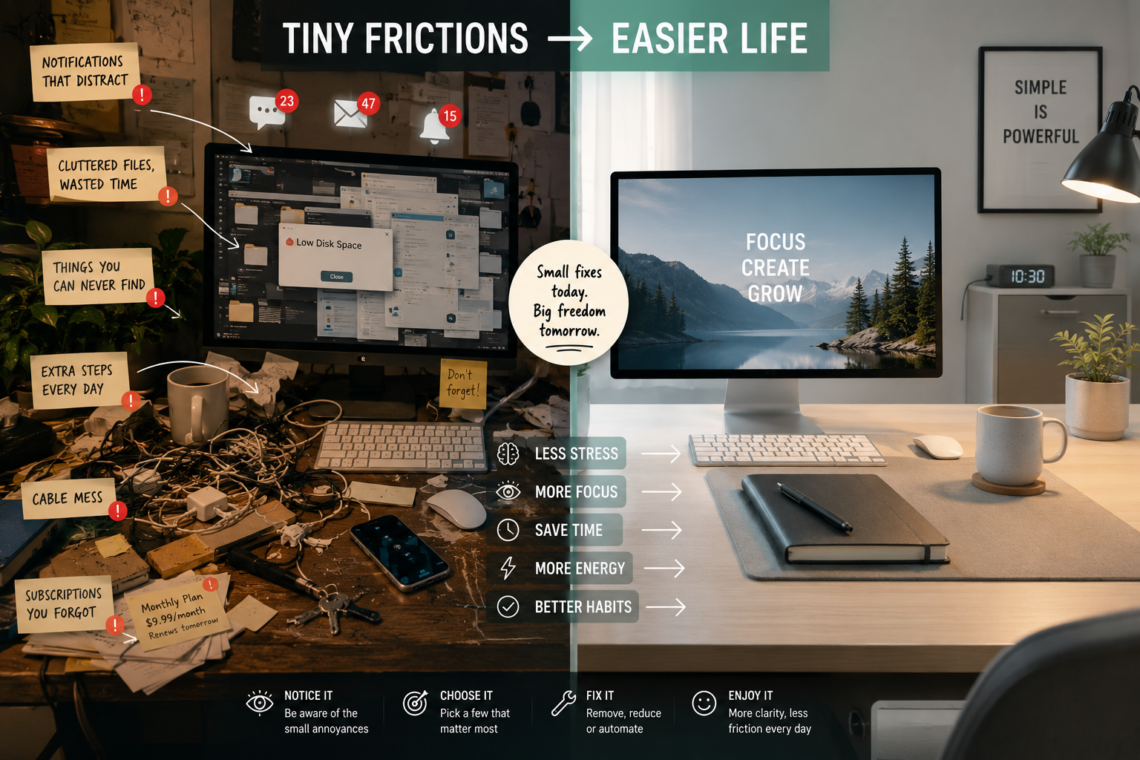
It’s fifty tiny ones.
The charger that never reaches your chair.
The password you keep forgetting.
The document you can never find.
The drawer that sticks every morning.
The app that sends useless notifications.
The shoes sitting exactly where you nearly trip over them every day.
The website that requires six clicks for something you do constantly.
The subscription you’re still meaning to cancel.
None of these things is important enough to ruin your day.
That’s precisely why they survive.
They are too small to fix urgently.
But just large enough to annoy you repeatedly.
I call them micro-frictions.
And once you start noticing them, they’re everywhere.
What Is a Micro-Friction?
A micro-friction is a small obstacle that makes an ordinary action slightly harder, slower, more annoying, or more mentally demanding than it needs to be.
The key word is slightly.
If your laptop completely stops working, that’s not micro-friction.
That’s a problem.
If your laptop charger falls behind the desk three times a week and you have to crawl under the table to retrieve it?
Micro-friction.
If you lose your passport the night before an international flight?
Problem.
If every time you need an important document you spend four minutes searching three folders because you never decided where it should live?
Micro-friction.
These things rarely feel serious enough to deserve attention.
So we tolerate them.
Again.
And again.
And again.
The Coffee Mug Example
Imagine your coffee mugs live in a cupboard on the other side of the kitchen from the coffee machine.
This adds maybe six seconds to your morning.
Who cares?
Six seconds is nothing.
So you leave them there.
But suppose you make coffee twice a day.
That’s twelve unnecessary seconds.
Still meaningless.
Until you realize micro-friction isn’t mainly about time.
It’s about repeated interruption.
Every unnecessary step asks your brain to perform another tiny action.
Open cupboard.
Walk over.
Find mug.
Return.
Move something.
Continue.
You barely notice it consciously.
But your day contains hundreds of these transitions.
Life becomes less about performing meaningful actions and more about constantly navigating tiny obstacles around them.
Why Small Annoyances Survive for Years
Big problems create urgency.
Small problems create adaptation.
Your door handle becomes loose.
You learn to lift it slightly.
Your charging cable stops working at certain angles.
You bend it exactly right.
Your keyboard key sticks.
You press harder.
Your desktop becomes chaotic.
You learn approximately where things are.
Your bag has a broken zipper.
You stop using that compartment.
Humans are excellent at adapting.
Unfortunately, this means we sometimes become extremely efficient at tolerating bad systems.
Instead of fixing the environment, we train ourselves around it.
And eventually the workaround feels normal.
You May Already Have a Collection
Look around your workspace right now.
Is there anything you regularly think:
« I really should fix that. »
Maybe it’s:
A cable situation.
An uncomfortable chair position.
A slow computer startup.
An overflowing downloads folder.
A light that’s slightly too dim.
A notebook you can never find.
A browser with 38 tabs.
A printer you avoid because connecting to it feels like negotiating with a government agency.
If you immediately thought of three things, congratulations.
You’ve found your first friction cluster.
Micro-Frictions Exist Everywhere
They’re not just physical.
Digital friction
Forgotten passwords.
Poorly organized files.
Too many notifications.
Duplicate apps.
Unnecessary login steps.
Bookmarks scattered everywhere.
Browser tabs permanently open because « you might need them. »
Work friction
Unclear priorities.
Meetings without agendas.
Files without consistent names.
Repeated questions nobody documents.
Tasks without clear next actions.
Constant context switching.
Home friction
Objects stored far from where they’re used.
Missing batteries.
Messy entryways.
Important items without permanent locations.
Things that constantly need moving before something else can happen.
Mental friction
Unmade decisions.
Tasks kept in memory.
Vague plans.
Open commitments.
Things you’re « supposed to get around to. »
Social friction
Group chats you don’t need.
Notifications from conversations that aren’t relevant.
Unclear expectations.
Plans nobody has actually confirmed.
None of these is catastrophic.
That’s why they’re dangerous.
Friction Compounds
Imagine a normal morning.
Your alarm rings.
Your phone battery is lower than expected because the cable wasn’t properly connected.
You get dressed.
You can’t find one thing you wanted to wear.
You go to the kitchen.
You’re out of coffee filters.
You use another method.
You open your laptop.
It installs an update.
You finally start working.
You need a file.
You can’t remember where you saved it.
A notification appears.
You check it.
Now you’re in your inbox.
Ten minutes later, you’ve forgotten why you opened the computer.
No single event caused the frustration.
But the sequence has momentum.
By 9:15 AM, you may already feel as if life is resisting you.
That’s friction accumulation.
The Strange Psychology of “I’ll Fix It Later”
Micro-frictions often survive because fixing them requires a small investment now in exchange for a future benefit.
And our brains aren’t always great at that trade.
Moving the charger clip takes five minutes.
Searching for the charger today takes only twenty seconds.
So we spend twenty seconds.
Tomorrow?
Twenty seconds.
Next week?
Again.
The five-minute fix continues losing to the twenty-second workaround.
This is how tiny inefficiencies live for three years.
Try the Friction Hunt
Here’s a simple experiment.
Set a timer for 10 minutes.
Walk through your environment.
Don’t clean anything yet.
Don’t organize.
Don’t optimize.
Just look for things that repeatedly create annoyance.
Write them down.
Ask yourself:
What do I regularly have to search for?
What do I repeatedly move out of the way?
Which action always requires more steps than it should?
What do I frequently forget?
What notification do I always dismiss?
What task keeps returning because I never fixed the underlying issue?
What makes me sigh before I even start?
That last question is surprisingly useful.
Your sigh is data.
Example Friction List
Your list might look like this:
Phone charger falls behind desk.
Can’t find receipts.
Too many promotional emails.
Water bottle always in kitchen.
Laptop desktop is cluttered.
Forget gym clothes.
Need to log into same website every morning.
Always run out of printer paper.
Keys have no permanent location.
Keep forgetting one recurring payment.
Desk lamp cable is too short.
Calendar reminders appear too late.
Individually?
Tiny.
Together?
A system begging for maintenance.
Don’t Fix Everything
This is important.
The friction hunt should not become another productivity project requiring a dashboard, three apps, and a color-coded spreadsheet.
Choose three.
Preferably problems that:
Happen frequently.
Take little time to fix.
Create disproportionate annoyance.
Let’s say you choose:
1. Charger falls behind desk
Fix: cable clip.
Time: two minutes.
2. Keys disappear
Fix: one permanent bowl near the door.
Time: thirty seconds.
3. Promotional notifications
Fix: disable them.
Time: five minutes.
Total repair time?
Less than ten minutes.
Future annoyance removed?
Potentially hundreds of repetitions.
That’s a good trade.
The Repetition Test
Here’s my favorite rule:
If something annoys you three times, don’t just solve the incident. Examine the system.
The first time?
Could be random.
Second time?
Interesting.
Third time?
Pattern.
If you’re always looking for something, it doesn’t have a home.
If you’re always late to the same type of appointment, your preparation system may be wrong.
If you’re always forgetting a recurring task, don’t « try harder to remember. »
Create a reminder.
If you’re repeatedly answering the same question, document the answer.
If a task constantly feels difficult to start, maybe the first step isn’t clear enough.
Repeated problems often deserve structural solutions.
Your Environment Is Quietly Training You
We often think habits are entirely about discipline.
But environments shape behavior constantly.
Put fruit where you can see it and you’re more likely to eat it.
Put your phone on the desk and you’re more likely to touch it.
Leave a guitar accessible and you’re more likely to play it.
Store exercise clothes somewhere inconvenient and exercise has one more obstacle.
The environment doesn’t force behavior.
It changes the cost.
And small differences in cost matter when they’re repeated every day.
That’s why removing friction can sometimes be more effective than adding motivation.
Make Good Actions Easier
Suppose you want to drink more water.
Option A:
Write « DRINK WATER!!! » on your to-do list.
Option B:
Keep a full bottle where you actually spend your day.
One requires repeated remembering.
The other changes the environment.
Want to read more?
You can set an ambitious reading target.
Or put the book on your pillow or beside the sofa instead of inside a cabinet.
Want to use your phone less at night?
You can rely on willpower.
Or charge it outside the bedroom.
Good systems don’t constantly demand heroic discipline.
They make the useful choice easier.
Make Bad Actions Slightly Harder
Friction works both ways.
Sometimes you want to add it.
Social media distracts you?
Log out.
Now opening it requires another step.
Online shopping too easy?
Remove saved payment details.
Phone interrupts work?
Put it in another room.
Snacking mindlessly?
Don’t keep snacks beside the desk.
You don’t need to make undesirable behavior impossible.
Sometimes adding only ten seconds of inconvenience creates enough space for a conscious decision.
That’s the interesting thing about friction.
Tiny barriers can produce surprisingly large behavioral effects.
The 30-Second Rule
Another useful question:
Could I permanently remove this annoyance in under 30 seconds?
If yes, consider doing it immediately.
Move the trash bin.
Bookmark the page.
Rename the file.
Turn off the notification.
Put the object where it belongs.
Delete the useless shortcut.
Add the reminder.
Thirty seconds today can eliminate dozens of future interruptions.
The Five-Minute Fix List
Some friction takes slightly longer.
Create a small list called:
Five-Minute Fixes
Not tasks.
Fixes.
Examples:
Unsubscribe from three newsletters.
Create folder for invoices.
Update saved address.
Move frequently used kitchen tool.
Set recurring reminder.
Clean up browser bookmarks.
Create email template.
Replace dead batteries.
Change default download folder.
Whenever you have a spare ten minutes, remove one or two.
This feels different from ordinary productivity because you’re not doing more work.
You’re making future work easier.
Beware of Fake Friction Removal
There’s a trap.
You decide to simplify your productivity system.
Two hours later you’re watching comparison videos about eleven new productivity apps.
You’ve created productivity friction while trying to remove productivity friction.
Classic.
Real simplification usually feels boring.
It looks like:
Deleting.
Moving.
Renaming.
Canceling.
Automating.
Choosing.
Stopping.
Not downloading another platform.
Sometimes the Friction Is Information
Not every difficult task needs to become easier.
Sometimes resistance is useful information.
If you’ve been postponing a project for months, don’t automatically assume you need a better productivity technique.
Maybe you don’t actually want to do the project.
If you continually avoid an app, maybe the app isn’t useful.
If nobody on your team follows a complicated process, perhaps the process is badly designed.
If your morning routine contains twelve steps and you constantly abandon it, the problem may not be discipline.
Maybe twelve steps is ridiculous.
Friction can reveal bad design.
The “Why Is This Here?” Question
Walk through your environment and ask:
Why is this here?
Why are the scissors stored here?
Why does this app have notification permission?
Why do I receive this newsletter?
Why is this folder named this way?
Why is this recurring meeting still happening?
Why do I perform these five steps every time?
Sometimes the answer is:
« Because that’s how I’ve always done it. »
That’s not necessarily a good reason.
Many inefficient systems are simply historical accidents that survived long enough to become traditions.
Friction and Decision Fatigue
Some friction doesn’t slow actions.
It creates decisions.
Where should I save this?
What should I call it?
Which app should I use?
When should I do it?
Where did I put that?
Should I reply now?
Should I keep this?
Decision after decision.
Small choices can create mental fatigue even when none of them matters much.
Defaults help.
One location for keys.
One app for tasks.
One folder for downloads you need to process.
One regular grocery list.
One place for documents.
The goal isn’t perfect organization.
It’s reducing unnecessary choices.
Create Homes for Things
A surprisingly powerful rule:
Frequently used things deserve obvious homes.
Keys.
Wallet.
Headphones.
Chargers.
Documents.
Passwords.
Tasks.
Notes.
If something important regularly disappears, it may not actually have a home.
A home isn’t:
« Somewhere around here. »
A home is:
« It goes exactly there. »
This sounds almost insultingly simple.
Yet it solves an extraordinary number of everyday problems.
Run the One-Week Experiment
Here’s your challenge.
For the next seven days, whenever something creates minor frustration, write it down.
Don’t judge it.
Even if it sounds ridiculous.
Day 1:
Couldn’t find headphones.
Day 2:
Entered same information manually again.
Day 3:
Forgot grocery item.
Day 4:
Moved charging cable again.
Day 5:
Got distracted by unnecessary notification.
Day 6:
Couldn’t find old document.
Day 7:
Forgot to cancel something.
At the end of the week, circle anything that happened more than once.
Those are your high-value targets.
Ask Three Questions
For each repeated friction:
Can I remove it?
Example:
Useless notifications.
Yes.
Remove.
Can I reduce it?
Example:
Long recurring process.
Maybe create a shortcut or template.
Reduce.
Can I automate it?
Example:
Recurring bill or reminder.
Potentially.
Automate.
You don’t need a sophisticated solution.
You need fewer repetitions of unnecessary effort.
The Bigger Idea
Productivity advice often asks:
How can I become better at doing things?
Micro-friction asks a different question:
Why is this thing unnecessarily difficult in the first place?
That’s a powerful shift.
Instead of constantly improving yourself, occasionally improve the system around yourself.
Maybe you don’t need better memory.
You need a reminder.
Maybe you don’t need more discipline.
You need fewer distractions.
Maybe you don’t need faster typing.
You need a template.
Maybe you don’t need to become better at finding things.
Things need permanent homes.
Maybe you don’t need another productivity method.
You need to remove four annoying steps.
Life Doesn’t Need to Become Frictionless
Some friction is good.
Learning something difficult requires effort.
Exercise requires effort.
Relationships require effort.
Meaningful work requires effort.
We shouldn’t attempt to turn life into one enormous convenience machine.
The goal isn’t removing meaningful difficulty.
It’s removing meaningless difficulty.
There’s a huge difference.
Writing a book is hard.
Finding the document every morning shouldn’t be.
Training for a marathon is hard.
Finding your shoes shouldn’t be.
Running a business is hard.
Resetting the same forgotten password every week shouldn’t be.
Save your energy for the difficulty that matters.
Final Thoughts
We tend to search for dramatic improvements.
A new routine.
A better app.
A major lifestyle change.
A breakthrough technique.
But some of the best improvements are almost embarrassingly small.
Move the charger.
Create the folder.
Turn off the notification.
Put the keys by the door.
Write down the recurring task.
Cancel the thing.
Fix the drawer.
Ten minutes later, nothing revolutionary has happened.
You haven’t transformed your life.
You haven’t become a productivity genius.
You haven’t unlocked your maximum human potential.
You’ve simply made tomorrow slightly easier.
And then the next day.
And the next.
That’s the hidden power of removing friction.
Small problems don’t look important.
But when they happen every day, small improvements don’t stay small either.