Two people can face exactly the same problem and see two completely different situations.
One immediately starts analyzing the facts.
Another begins imagining unusual solutions.
Someone else creates a detailed plan.
And then there’s the person who says, « I have no idea why, but I think we should try this. »
Surprisingly, they might all be right.
The way you approach problems says a lot about how you think, make decisions, work with other people, and respond when things don’t go according to plan.
So what kind of thinker are you?
This short quiz won’t measure how « smart » you are. That’s not the point. Instead, it will help you recognize the problem-solving style you naturally rely on most.
There are no wrong answers.
Choose the option that sounds most like what you would actually do — not what you think you should do.
Keep track of your letters.
Ready?
Let’s see what your brain does when life refuses to cooperate.
Question 1: Your Laptop Suddenly Stops Working
You have something important to finish. Your laptop freezes and refuses to cooperate.
What do you do first?
A) Look for the cause and systematically eliminate possible problems.
B) Think of an alternative way to complete the task without the laptop.
C) Decide what needs to be done first and create a backup plan.
D) Start trying different fixes until something works.
E) Go with the solution that instinctively feels most likely to work.
Question 2: You’re Given a Project With Almost No Instructions
Your manager, teacher, or client gives you a vague assignment and says:
« Do something interesting with this. »
Your reaction?
A) I start gathering information and clarifying the requirements.
B) Perfect. I immediately start imagining possibilities.
C) I define the objective, deadline, and major steps.
D) I create a rough version and improve it as I go.
E) I think about the project for a while until an idea feels right.
Question 3: You Get Lost in an Unfamiliar City
Your phone battery is almost dead.
What happens next?
A) I study street names, signs, and landmarks to determine where I am.
B) I look for an unconventional shortcut or alternative route.
C) I identify my destination and build the safest route possible.
D) I start walking in the direction that seems promising and adjust along the way.
E) I follow my sense of direction.
Hopefully it’s having a good day.
Question 4: Someone Disagrees With Your Idea
What’s your natural response?
A) « Show me why you think I’m wrong. »
B) « Interesting. What if we combined both ideas? »
C) « Which solution gets us closer to the objective? »
D) « Let’s test both and see what happens. »
E) « I understand your argument, but something still doesn’t feel right. »
Question 5: You Have to Make an Important Decision
You usually rely most on:
A) Facts and evidence.
B) Possibilities and imagination.
C) Consequences and long-term outcomes.
D) Real-world experimentation.
E) Experience and instinct.
Question 6: You’re Stuck on a Difficult Problem
After an hour, you’ve made almost no progress.
What do you do?
A) Break the problem into smaller pieces.
B) Step away and look at it from a completely different angle.
C) Return to the original objective and reconsider the strategy.
D) Try something — anything — to create movement.
E) Stop forcing it and allow the answer to come naturally.
Question 7: Which Sentence Sounds Most Like You?
A) « There must be a logical explanation. »
B) « There must be another way. »
C) « What’s the smartest way to approach this? »
D) « Let’s try it and find out. »
E) « I can’t explain it yet, but I have a feeling. »
Question 8: Your Team Has Five Ideas but Can Choose Only One
What role do you naturally take?
A) Compare the strengths and weaknesses of each idea.
B) Suggest a sixth idea nobody considered.
C) Determine which option best serves the long-term objective.
D) Suggest quickly testing the most promising options.
E) Notice which idea seems to have the strongest potential.
Question 9: When Something You Planned Goes Completely Wrong…
A) I want to understand exactly why it failed.
B) I get excited about finding another solution.
C) I adjust the plan.
D) I improvise.
E) I trust myself to figure it out.
Question 10: Pick Your Ideal Superpower
Yes, this is scientifically questionable.
Choose anyway.
A) Knowing the answer to every question.
B) Creating anything you can imagine.
C) Seeing the consequences of every decision.
D) Being able to instantly learn from every mistake.
E) Knowing when something is about to happen.
Time to Discover Your Thinking Style
Count how many A, B, C, D, and E answers you selected.
Whichever letter appears most often reveals your dominant problem-solving style.
If two letters are tied, congratulations: your brain apparently refused to fit neatly into my quiz.
Read both profiles. You’re probably a combination of the two.
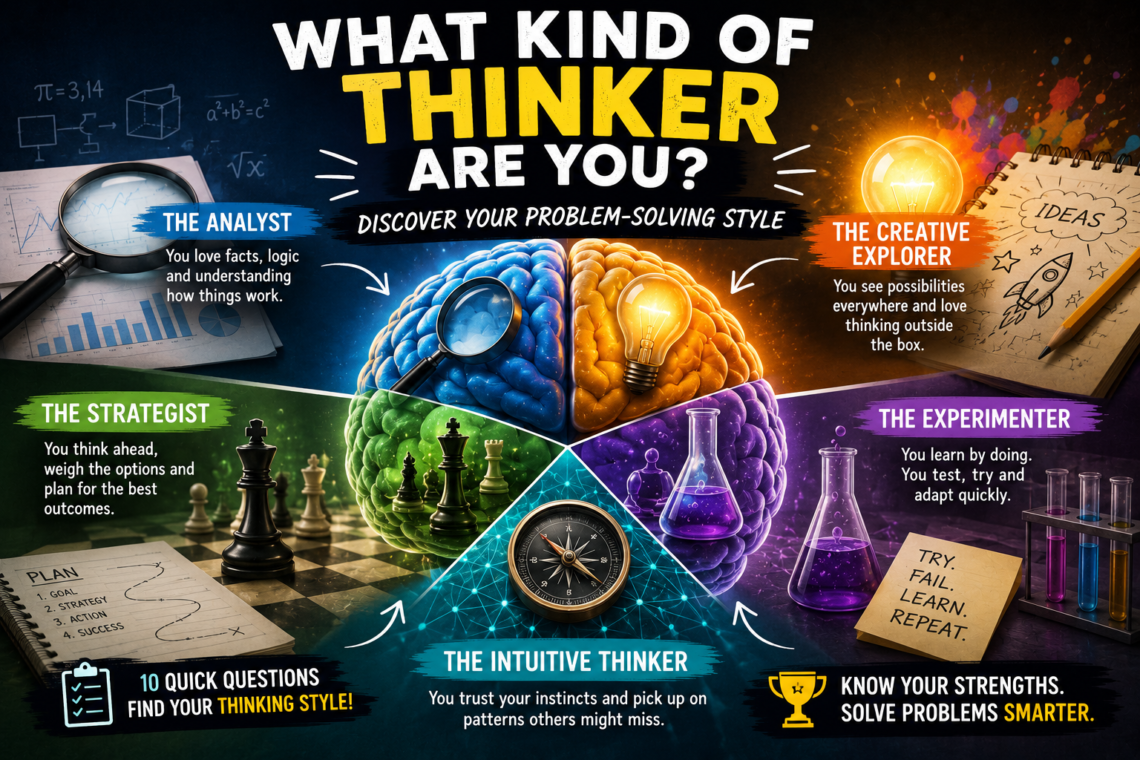
Mostly A — The Analyst 🔍
Your brain loves evidence.
When something goes wrong, your first instinct isn’t necessarily to panic or improvise. You want to understand why it happened.
You notice inconsistencies, ask questions, compare information, and prefer decisions supported by evidence.
This makes you particularly strong when dealing with complicated problems where details matter.
Your Superpower
You can turn confusion into something understandable.
Your Potential Trap
Analysis can quietly become overanalysis.
Sometimes there isn’t enough information to guarantee the perfect decision.
At some point, thinking has to become doing.
Try This
When you’re stuck analyzing a decision, ask:
« What is the smallest decision I can make with the information I already have? »
You don’t always need the complete answer to take the next step.
Mostly B — The Creative Explorer 💡
Your brain doesn’t just look for answers.
It looks for possibilities.
When other people see two options, you often wonder why there can’t be a third, fourth, or completely different one.
You’re naturally good at connecting ideas that don’t obviously belong together.
Your Superpower
Originality.
You can often escape problems by changing the question instead of endlessly searching for the expected answer.
Your Potential Trap
Ideas are exciting.
Execution is less exciting.
You may generate ten excellent possibilities and struggle to commit to one.
Try This
After brainstorming, force yourself to choose one idea and test it.
Creativity becomes valuable when imagination eventually meets reality.
Mostly C — The Strategist ♟️
You naturally think several steps ahead.
You’re less interested in finding a solution than finding the solution that creates the best outcome over time.
Before acting, you often consider priorities, consequences, resources, and risks.
Your Superpower
Direction.
You can take complicated situations and identify what actually matters.
Your Potential Trap
Life doesn’t always follow the plan.
Too much planning can create frustration when unpredictable events appear.
And they always appear.
Try This
Build flexibility into your plans.
Instead of creating one perfect route, create a strong direction with several possible routes.
Strategy works best when it can survive reality.
Mostly D — The Experimenter 🧪
You believe problems are solved by interacting with them.
While everyone else is still discussing possibilities, you’ve already pressed the button.
Sometimes that button should not have been pressed.
But at least now everyone knows.
You learn quickly because you prefer feedback from reality over endless speculation.
Your Superpower
Momentum.
You transform uncertainty into information by taking action.
Your Potential Trap
Moving quickly can create avoidable mistakes.
Not every experiment is cheap or reversible.
Try This
Before acting, ask:
« If this fails, what will it cost me? »
If the downside is small, experiment.
If the downside is serious, slow down and think.
Mostly E — The Intuitive Thinker 🧭
Sometimes you know something before you can explain why.
That doesn’t necessarily mean magic is happening.
Your brain constantly absorbs patterns from previous experiences, conversations, observations, and mistakes. Sometimes those patterns produce a feeling before your conscious mind can explain the reasoning behind it.
Your Superpower
Pattern recognition.
You may notice subtle signals that other people overlook.
Your Potential Trap
Intuition can be useful, but feelings aren’t automatically facts.
Sometimes instincts are influenced by assumptions, fear, or previous experiences that don’t apply to the current situation.
Try This
Use intuition to generate a hypothesis, then look for evidence.
Instead of:
« I feel this is correct, therefore it is correct. »
Try:
« I feel this might be correct. What evidence would confirm or challenge that feeling? »
That’s intuition and reasoning working together.
What If You Have Two Strong Results?
That’s completely normal.
Real people rarely belong to one neat category.
You might be an Analyst + Strategist, carefully examining information before building a plan.
You could be a Creative + Experimenter, constantly inventing ideas and immediately testing them.
Or perhaps you’re an Intuitive + Analyst, noticing something instinctively and then searching for evidence to understand why.
Your combination may actually be more useful than your dominant type alone.
The Best Problem Solvers Don’t Use Just One Style
Here’s the most important part of the quiz.
Your natural thinking style is a strength, but it can also become a limitation if it’s the only way you approach problems.
Great problem-solving often requires moving between different modes of thinking.
First, the Analyst asks:
« What is actually happening? »
Then the Creative Explorer asks:
« What else could we do? »
The Strategist asks:
« Which option makes the most sense long-term? »
The Experimenter says:
« Let’s test it. »
And the Intuitive Thinker occasionally interrupts everyone with:
« I don’t know why, but something about this feels wrong. »
Sometimes that’s exactly the warning everyone needed.
The goal isn’t to replace your natural style.
It’s to expand your toolbox.
A Small Challenge for Your Next Problem
The next time you encounter a frustrating problem, notice your automatic reaction.
Then deliberately try the opposite approach.
If you’re an Analyst, experiment before you have every answer.
If you’re an Experimenter, analyze before acting.
If you’re a Strategist, allow yourself to improvise.
If you’re Creative, impose one useful constraint.
If you’re Intuitive, challenge your instinct with evidence.
You might discover that the solution was hiding in a way of thinking you don’t normally use.
Final Thought
Problems don’t reveal only what we know.
They reveal how we think.
Understanding your natural problem-solving style won’t magically make every decision easy. But it can help you recognize your strengths, catch your blind spots, communicate better with people who think differently, and approach difficult situations with more flexibility.
So, what kind of thinker are you?
The Analyst? The Creative Explorer? The Strategist? The Experimenter? Or the Intuitive Thinker?
And perhaps the more interesting question is:
Which type could you learn from next?